
headhunter platform
What Makes a Great Headhunter Platform

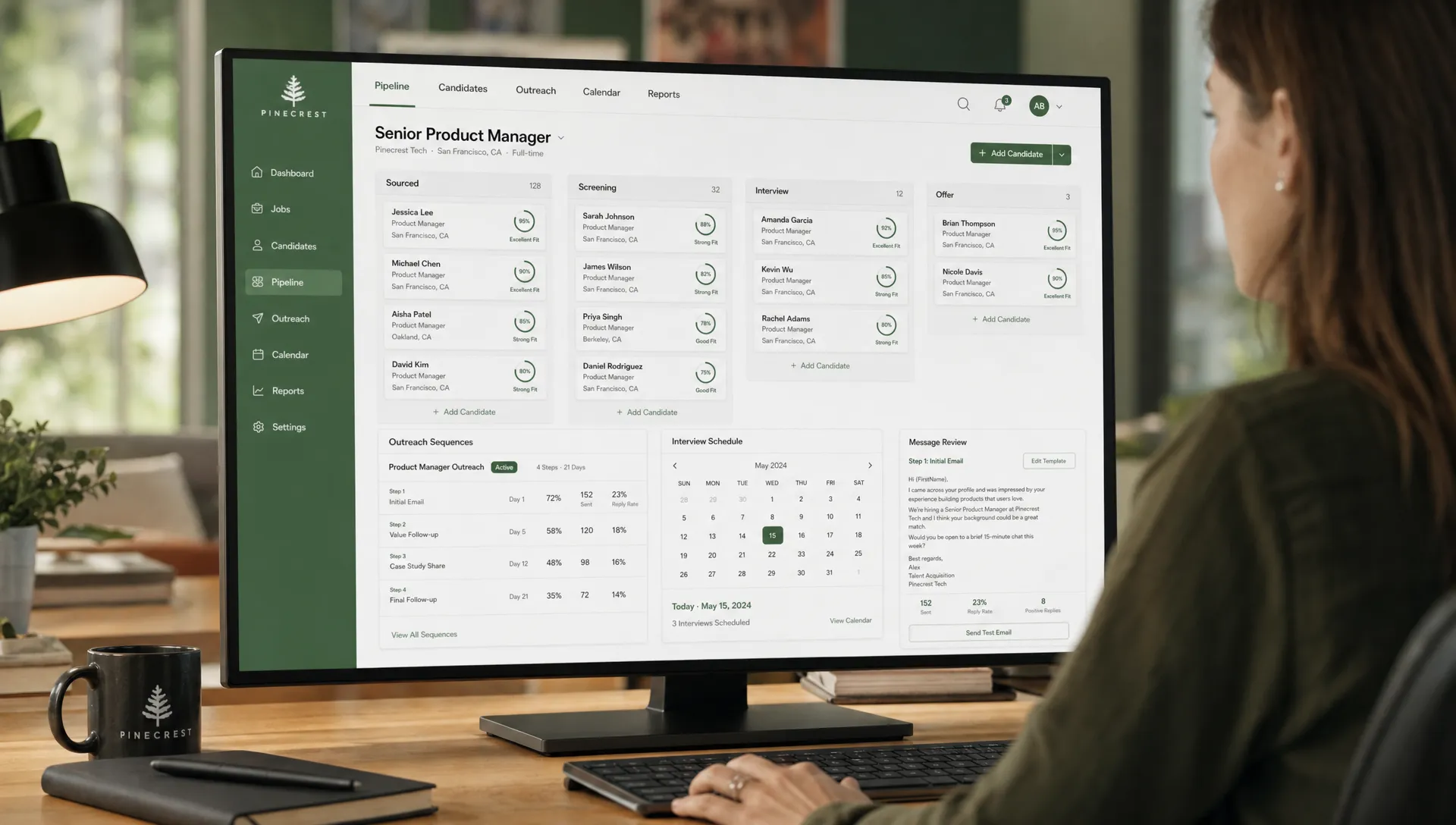
A great headhunter platform does not replace the judgment, network, or persuasion skills that make a recruiter valuable. It removes the drag around that work, so headhunters can spend more time understanding clients, engaging hard-to-reach candidates, and moving the right people through the process with confidence.
That distinction matters. Headhunting is not the same as processing inbound applicants. The best candidates are often passive, busy, skeptical, or already well compensated. Clients expect nuance, speed, market intelligence, and a shortlist they can trust. A generic applicant tracking system may keep records organized, but it rarely supports the full rhythm of executive search, agency recruitment, or specialist talent acquisition.
So what makes a great headhunter platform? In short, it should combine structured intake, evidence-based screening, personalized outreach, scheduling automation, clean integrations, compliance controls, and a candidate experience that feels high-touch rather than automated.
A great headhunter platform starts with the work headhunters actually do
Before comparing features, it helps to define the job a headhunter platform is meant to support.
Headhunters operate at the intersection of client advisory, market mapping, candidate persuasion, and process coordination. They need to translate vague hiring needs into practical search criteria, identify candidates who may not be actively looking, personalize outreach, handle objections, manage interviews, and keep clients informed without flooding them with irrelevant profiles.
That means the platform must be more than a database. It should help recruiters answer questions like:
- What does the client truly need, beyond the job description?
- Which candidates match the role, and what evidence supports that match?
- Which outreach message is most likely to earn a response?
- Who needs a follow-up today?
- Which interviews, calls, and pipeline updates are at risk of slipping?
- What can be automated safely, and what needs recruiter approval?
If a system only stores candidates, it is not really a headhunter platform. It is a filing cabinet. A great platform becomes the operating layer for the search.
Structured intake is the foundation
The quality of a search is often decided before the first candidate is contacted. Weak intake creates vague criteria, inconsistent screening, and misaligned shortlists. Strong intake creates a shared definition of success.
A great headhunter platform should turn client briefs, hiring manager notes, job descriptions, and recruiter context into a usable search framework. That framework should capture must-have requirements, nice-to-have signals, dealbreakers, compensation realities, location expectations, seniority level, business context, and the type of evidence needed to support a recommendation.
This is especially important for agencies and executive search teams managing multiple clients. Two roles can have the same title and require completely different candidate profiles. A “Head of Sales” for a founder-led startup is not the same as a “Head of Sales” for a private equity-backed scale-up. The platform should help preserve those distinctions.
If you are comparing tools across a broader hiring stack, CandiDesk’s guide on how to choose a talent acquisition platform provides a useful framework for mapping software decisions to real workflow needs.
Candidate scoring should be evidence-based, not mysterious
AI can help recruiters evaluate candidates faster, but speed is only useful when the reasoning is visible. A great headhunter platform should not simply label someone as a “92% match” without showing why.
Evidence-based scoring means the platform connects its recommendations to specific candidate data, such as relevant experience, required skills, industry background, seniority indicators, location fit, language requirements, or prior achievements. Recruiters should be able to review the evidence, correct it, and use it to explain decisions to clients.
This matters for three reasons.
First, it improves trust. Recruiters are more likely to rely on a score when they can inspect the reasoning behind it. Second, it improves client communication. A shortlist is stronger when every candidate comes with a clear rationale. Third, it supports fairer and more consistent evaluation, because decisions are tied to job-relevant criteria rather than gut feel alone.
The warning sign is black-box ranking. If a platform cannot explain why one candidate is ranked above another, recruiters should be cautious. Modern AI can assist, but it should not hide the logic that affects candidate outcomes.
Outreach should be personalized and human-approved
Headhunting lives or dies on outreach quality. Passive candidates can tell immediately when a message is generic. The right platform should help recruiters draft faster without sounding robotic, careless, or mass-produced.
A strong headhunter platform should generate outreach drafts based on the role, candidate background, client context, and recruiter intent. It should also let recruiters approve or edit every message before it sends. That human approval step is not a minor detail. It protects the employer brand, preserves candidate trust, and keeps recruiters accountable for the tone and accuracy of communication.
Multi-language outreach can also be valuable for international searches, especially when agencies or HR teams work across regions. The key is not simply translating words. The platform should support communication that feels appropriate for the market, seniority level, and candidate relationship.
Automation should make outreach more relevant, not more aggressive. If a tool encourages high-volume spam, it may create short-term activity while damaging long-term relationships.
Scheduling and follow-up should happen without constant chasing
Interview coordination is one of the least glamorous parts of recruiting, but it has a major impact on speed and candidate experience. A candidate who waits three days for available times may lose interest. A client who misses an update may assume the search has stalled.
A great headhunter platform should automate scheduling, reminders, rescheduling, and pipeline updates wherever possible. It should coordinate calendars, reduce back-and-forth messages, and keep recruiters informed when human intervention is needed.
This is where always-on support becomes useful. Candidates may respond outside business hours, especially if they are currently employed. A platform that can handle routine conversations, share job information, and keep scheduling moving around the clock gives recruiters a meaningful advantage. CandiDesk’s 24/7 Assistant is built around that idea: an AI recruitment assistant that supports conversations and coordination while keeping recruiters in control.
The best platforms integrate with the tools recruiters already use
Recruiting teams rarely operate from a blank slate. They already have an ATS, CRM, email, calendars, calling tools, messaging channels, spreadsheets, and reporting workflows. A great headhunter platform should fit into that ecosystem rather than force a disruptive rebuild.
Useful integrations reduce duplicate work. Candidate notes should not need to be copied manually from one system to another. Interview times should sync with calendars. Pipeline changes should appear where recruiters and hiring teams already work. Outreach and conversation history should remain accessible for future context.
The practical question is simple: does the platform make recruiters faster inside their current workflow, or does it create another tab to manage?
| Capability | What a great headhunter platform enables | Red flag to avoid |
|---|---|---|
| Intake | Converts briefs into structured search criteria | Relies only on pasted job descriptions |
| Screening | Shows candidate scores with supporting evidence | Uses unexplained black-box rankings |
| Outreach | Drafts personalized messages for recruiter approval | Sends generic automated messages at scale |
| Scheduling | Coordinates interviews, reminders, and rescheduling | Still requires manual calendar chasing |
| Integrations | Syncs with ATS, CRM, calendar, and communication tools | Creates duplicate records and extra admin |
| Compliance | Supports auditability, privacy, and recruiter oversight | Makes vague claims without controls |
Candidate experience is part of search quality
A headhunter platform should not optimize only for recruiter productivity. It should also protect the experience of the candidate, especially in senior or specialist searches where every interaction reflects on the recruiter and client.
That experience includes fast responses, accurate role information, respectful follow-up, clear scheduling, and thoughtful handling of sensitive information. For executive or confidential searches, discretion matters just as much as speed.
Sometimes candidate experience also extends beyond software. Final interviews, client meetings, and leadership assessments can involve travel, tight schedules, and VIP-level expectations. For high-stakes in-person meetings, a premium mobility partner for business transport such as Stuur Chauffeurs can help organizations coordinate reliable chauffeur services when candidate or executive travel needs to run smoothly.
The point is not that every search needs concierge logistics. The point is that high-touch recruiting depends on reducing friction at every stage. A platform should support that mindset by helping recruiters stay responsive, organized, and consistent.
Compliance, privacy, and AI governance cannot be afterthoughts
Recruitment involves personal data, sensitive career information, and decisions that affect people’s livelihoods. Any AI-enabled headhunter platform should be evaluated carefully for privacy, compliance, and governance.
In the United States, employers and vendors should pay attention to guidance from agencies such as the Equal Employment Opportunity Commission, including its resources on algorithmic decision-making and employment selection. In Europe and for global recruiting, GDPR obligations make data handling, consent, retention, and access controls especially important. The NIST AI Risk Management Framework is also a helpful reference for thinking about trustworthy AI systems.
A strong platform should support recruiter oversight, human approval, audit trails, and clear data handling practices. It should help teams understand how AI is being used, where recommendations come from, and what controls exist to prevent inappropriate automation.
This is particularly important in headhunting because candidate data may come from multiple sources and searches may be confidential. Recruiters need confidence that the platform supports professional standards rather than introducing hidden risk.
Reporting should measure quality, not just activity
Many recruiting tools track activity: messages sent, calls logged, profiles added, interviews booked. Those metrics are useful, but they are not enough.
A great headhunter platform should help teams measure search quality. That means understanding which sources produce qualified candidates, how quickly strong candidates move through the process, where candidates drop off, how clients respond to shortlists, and which outreach approaches generate meaningful replies.
Useful metrics for headhunters include:
- Time from intake to qualified shortlist
- Response rate by role type, market, or candidate segment
- Percentage of candidates with clear evidence attached to their score
- Interview scheduling latency
- Candidate drop-off by process stage
- Client feedback on shortlist relevance
- Source quality by placement or conversion outcome
Good reporting helps leaders coach recruiters, refine intake, improve client communication, and identify process bottlenecks. It also helps agencies show clients the value of their work with more than anecdotal updates.
What to ask before choosing a headhunter platform
A polished demo can make almost any recruiting tool look impressive. The real test is whether the platform improves the way your team already works.
Before choosing a headhunter platform, ask vendors practical questions grounded in your day-to-day workflow. How does the tool build a search brief? Can recruiters edit AI-generated criteria? How does candidate scoring work, and what evidence is shown? Can every outreach message require human approval? Does the platform support voice, chat, email, or all of them? Which ATS, CRM, calendar, and communication tools does it integrate with? How are candidate data, consent, and retention handled?
It is also worth asking for a workflow-based pilot. Use a real role, real intake notes, and a realistic candidate set. Then evaluate whether the platform improves speed, consistency, and candidate experience without reducing recruiter control.
For teams specifically evaluating AI capabilities, CandiDesk’s article on what to look for in AI recruitment software covers many of the same decision points from a broader automation and governance perspective.
How CandiDesk fits the headhunter platform category
CandiDesk is designed for agencies and HR teams that want AI support across the recruiting workflow while keeping people in control. That balance is important for headhunters because automation should accelerate the search, not take over the relationship.
CandiDesk supports smart intake from client briefs, candidate scoring with evidence, AI chat and voice calls, human-approved outreach drafting, interview scheduling automation, pipeline and calendar sync, multi-language outreach, and integrations with existing ATS, CRM, and communication tools. Its 24/7 assistant workflow helps keep conversations and coordination moving, while GDPR-focused data handling supports teams that need a more disciplined approach to candidate information.
In practice, the value is not one isolated feature. It is the way those features connect. Intake informs scoring. Scoring informs outreach. Outreach leads to conversations. Conversations lead to scheduling. Scheduling updates the pipeline. Recruiters remain involved where judgment, persuasion, and approval matter most.
That is what a great headhunter platform should do: create leverage without removing the human expertise that makes search work.
Frequently Asked Questions
What is a headhunter platform? A headhunter platform is software that helps recruiters and search teams manage the full candidate search workflow, including intake, sourcing support, screening, outreach, scheduling, pipeline updates, and client communication.
How is a headhunter platform different from an ATS? An ATS typically manages applicants and hiring workflows, while a headhunter platform is more focused on proactive search, passive candidate engagement, evidence-based shortlisting, and relationship-driven recruiting.
Should a headhunter platform use AI? AI can be valuable when it supports structured intake, candidate scoring, outreach drafting, scheduling, and follow-up. The best platforms keep recruiters in control and make AI recommendations transparent.
What is the biggest red flag when evaluating a headhunter platform? The biggest red flag is automation without visibility or control. If the platform ranks candidates, sends messages, or updates pipelines without clear reasoning and human oversight, it can create quality, compliance, and relationship risks.
What should agencies prioritize in a headhunter platform? Agencies should prioritize multi-client workflow support, strong intake, evidence-based screening, CRM and ATS integrations, human-approved communication, scheduling automation, and reporting that shows shortlist quality and process performance.
Build a search process that moves faster without losing the human touch
A great headhunter platform helps recruiters do what they do best: understand the role, judge fit, build trust, and guide candidates and clients through a high-stakes decision. The right software removes manual friction from intake, screening, outreach, scheduling, and pipeline updates while keeping recruiter judgment at the center.
If your team is looking for an AI-first recruitment platform that supports agencies and HR teams across those workflows, explore CandiDesk and see how a human-controlled AI assistant can help you hire faster and more consistently.

Nikon Mazur
Nikon is a recruiting technology specialist with over five years of hands on experience building HR and hiring software, and the co founder of CandiDesk.
LinkedIn Profile