
recruitment management platform
How a Recruitment Management Platform Adds Control
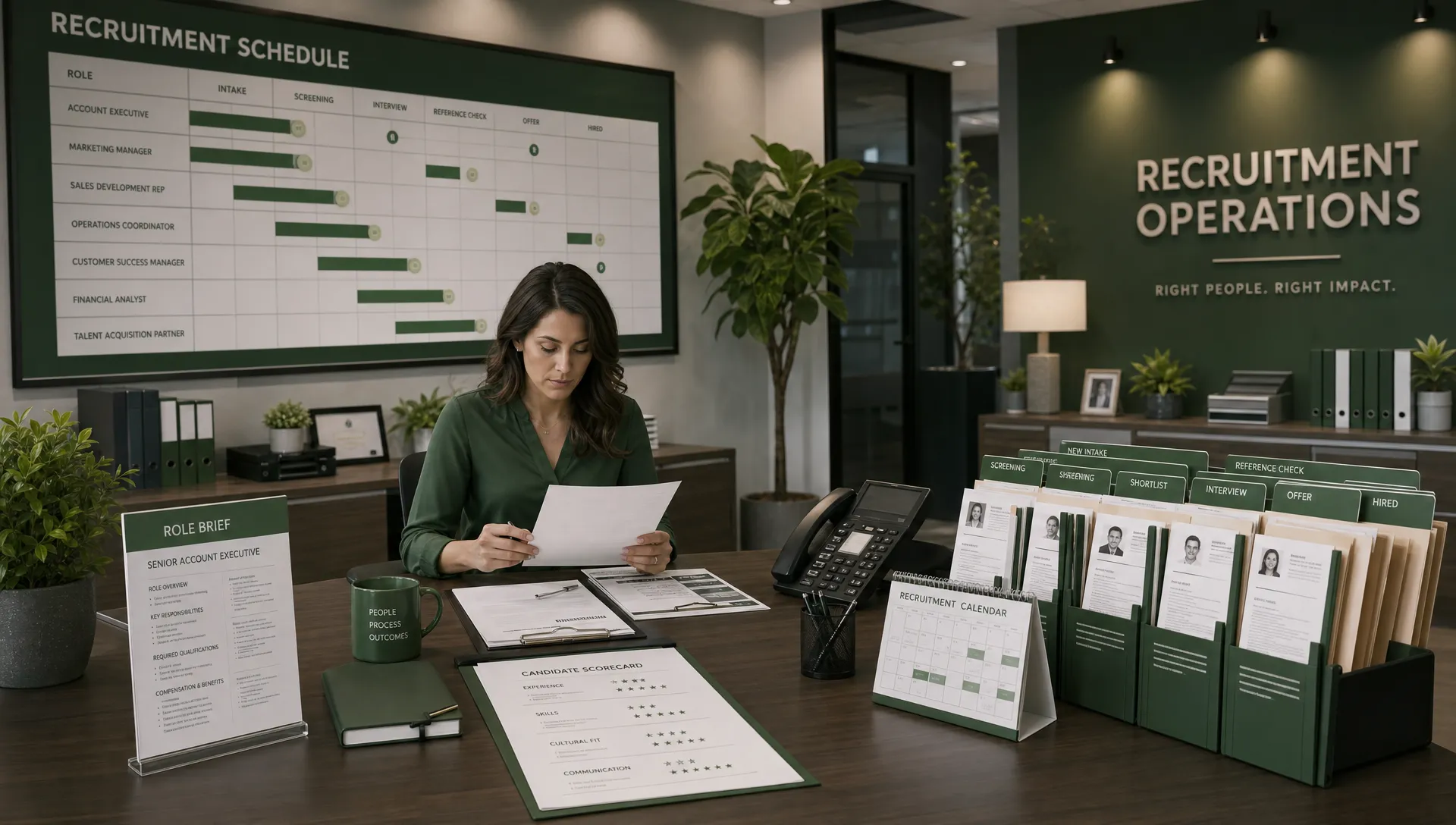
Recruiting teams rarely lose control all at once. It usually happens in small ways: one role brief is missing must-have criteria, one candidate is advanced without clear evidence, one follow-up is delayed, one interview is rescheduled outside the ATS, and one client asks for an update that requires three people to reconstruct the truth.
A recruitment management platform adds control by turning those fragile handoffs into a structured operating system. It does not remove recruiter judgment. The best platforms protect it by giving teams shared context, consistent workflows, visible approvals, and reliable records.
For staffing agencies, that control protects margins and client trust. For internal HR teams, it protects candidate experience, hiring consistency, and compliance. In both cases, the value is not just “more automation.” The value is knowing what is happening, why it is happening, who approved it, and what should happen next.
What “control” really means in recruitment
Control in recruitment is often misunderstood. It is not about slowing recruiters down with rigid admin steps. It is about creating a hiring process where speed does not depend on memory, personal inboxes, or manual status checks.
A controlled recruiting workflow gives teams five things: clarity, consistency, accountability, visibility, and room for human decision-making. When those elements are missing, automation can actually create more risk because tasks happen faster without enough oversight.
| Area of control | Common problem without structure | What a recruitment management platform adds |
|---|---|---|
| Intake | Vague briefs, inconsistent requirements, unclear priorities | Structured role criteria and aligned expectations before sourcing begins |
| Screening | Decisions based on scattered notes or gut feel | Candidate scoring supported by evidence from profiles, resumes, and conversations |
| Communication | Inconsistent outreach, missed follow-ups, off-brand messaging | Drafted outreach with human approval before sending |
| Scheduling | Manual coordination, calendar conflicts, slow response times | Interview scheduling automation and calendar sync |
| Reporting | Status updates built from memory or spreadsheet cleanup | Pipeline updates that reflect current recruiting activity |
| Compliance | Hard-to-audit decisions and unclear data handling | More traceable workflows and privacy-aware process design |
This is especially important as recruiting teams adopt AI. AI can reduce repetitive work, but it should operate inside guardrails. Recruiters still need to review messaging, challenge recommendations, and make context-aware decisions.
Better intake creates control before the search begins
Many hiring problems begin before the first candidate is contacted. If the intake is weak, every later step becomes harder to control. Recruiters screen against shifting criteria. Hiring managers change expectations mid-process. Candidates receive role information that does not match the real opportunity.
A recruitment management platform brings control to intake by making job requirements explicit. Instead of treating a client brief or hiring manager conversation as loose notes, the platform can help organize role details into structured criteria: responsibilities, must-have skills, nice-to-have skills, location expectations, compensation range, urgency, interview steps, and deal-breakers.
For staffing agencies, this is particularly valuable because different clients often provide briefs in different formats. A structured intake process creates a repeatable baseline without forcing every client to think the same way. Recruiters can still interpret nuance, but the system helps prevent essential requirements from being buried in a call transcript or email thread.
For internal HR teams, controlled intake improves alignment between recruiters and hiring managers. It reduces the classic problem of “that’s not what I meant” after the first slate of candidates has already been submitted.
If you are still comparing categories, CandiDesk’s guide on how to choose a talent acquisition platform is a useful companion because it frames platform selection around real workflow needs rather than feature checklists alone.
Evidence-based screening reduces subjective drift
Recruiters need judgment. They also need a way to explain that judgment. A strong recruitment management platform helps teams screen candidates with evidence rather than isolated impressions.
This matters because hiring criteria can drift during a search. One recruiter may prioritize domain experience, another may focus on tool familiarity, and a hiring manager may react strongly to one profile without explaining why. Over time, those differences create inconsistency, especially across high-volume roles.
Evidence-based candidate scoring gives teams a clearer decision trail. Instead of saying a candidate is “strong” or “not quite right,” recruiters can connect scores to the role brief. For example, the platform might surface that a candidate meets three must-have criteria, lacks one required certification, and has relevant experience in a similar market. The recruiter can then decide whether that gap is acceptable, but the reasoning is easier to review.
The goal is not to turn recruiting into a mechanical scoring exercise. It is to make the human decision more transparent. Recruiters can challenge the score, add context, and document why a candidate should move forward or be held back.
This becomes more important in agency environments where clients may ask why certain candidates were presented. It also helps internal teams maintain consistency across hiring managers, departments, and regions.
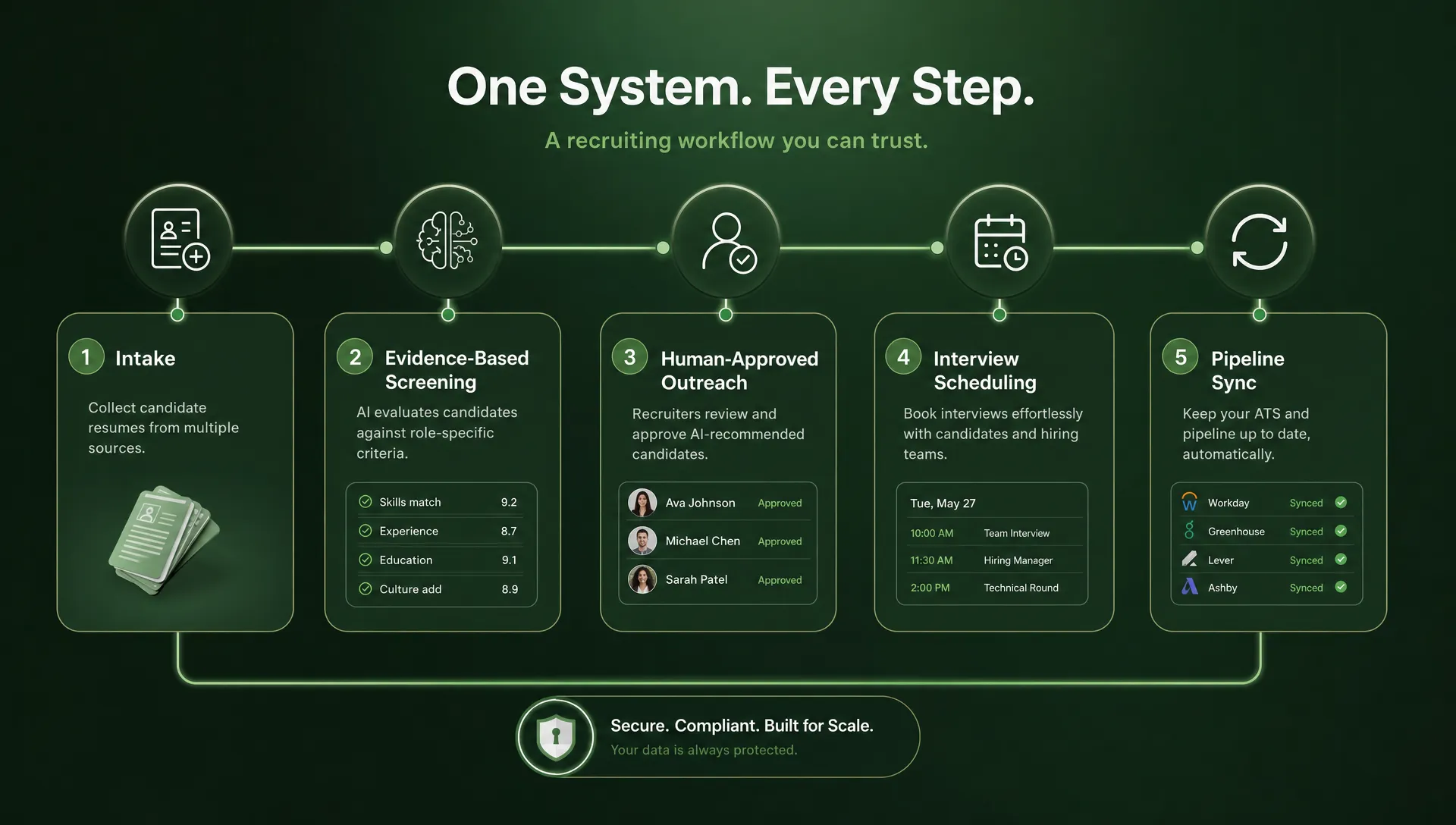
Human-approved communication keeps automation accountable
Candidate communication is one of the biggest areas where teams want speed but cannot afford to lose control. Outreach needs to be timely, relevant, and brand-safe. Follow-ups need to happen consistently. Interview details need to be accurate. Rejection or nurture messages need the right tone.
AI can help draft messages faster, but unsupervised communication can create risk. A platform that supports human-approved outreach gives recruiters the best of both worlds: less repetitive writing and more control over what actually reaches candidates or clients.
This is one reason human approval workflows matter. When AI drafts outreach, recruiters can review the message, edit it, and approve it before it sends. That preserves the recruiter’s voice and protects the employer brand. It also reduces the chance of inaccurate claims, mismatched job details, or tone that feels generic.
The rise of public AI-text rewriting tools also shows why recruiting teams should not rely on superficial AI-detection signals as their governance strategy. A better approach is to design communication workflows around provenance, approval, and accountability. Teams should know which messages were AI-assisted, who reviewed them, and what was sent.
For agencies, controlled communication protects client relationships because outreach often reflects both the agency and the employer. For internal teams, it protects candidate experience, which can influence acceptance rates and employer reputation.
Scheduling control removes a hidden bottleneck
Interview scheduling sounds operational, but it has a direct impact on hiring outcomes. Slow scheduling causes candidate drop-off. Manual coordination consumes recruiter time. Calendar mistakes create frustration for candidates and hiring managers.
A recruitment management platform adds control by connecting scheduling to the rest of the workflow. If a candidate is advanced, the next step should not depend on a recruiter manually searching calendars, copying time zones, and sending multiple follow-up emails. Scheduling automation can help coordinate availability, book interviews, handle reschedules, and keep calendars aligned.
The control comes from synchronization. When scheduling is connected to the pipeline, recruiters do not have to guess whether an interview was booked, moved, or missed. Status changes can be reflected in the systems teams already use, which reduces duplicate work and improves visibility.
For teams that need responsiveness outside normal working hours, CandiDesk’s 24/7 Assistant shows how always-on workflows can support candidate and client conversations, scheduling, and follow-up while keeping recruiters in control.
This kind of control matters more in competitive hiring markets. A qualified candidate may be speaking with several employers at once. If your team takes two days to coordinate a first interview while another company books within minutes, the process itself becomes a disadvantage.
Pipeline visibility turns recruiting into a managed process
Without a shared platform, pipeline visibility often depends on personal discipline. One recruiter updates the ATS immediately. Another waits until Friday. A third keeps notes in a private spreadsheet because the official system feels too slow. None of this is malicious, but it creates a fragmented view of hiring progress.
A recruitment management platform adds control by making the pipeline easier to keep current. When screening, outreach, calls, scheduling, and status updates are connected, the pipeline becomes a living view of the search rather than an after-the-fact reporting exercise.
This benefits recruiters because they spend less time rebuilding context. It benefits managers because they can identify bottlenecks earlier. It benefits clients and hiring managers because updates become more accurate and less dependent on manual chasing.
Pipeline control also helps teams compare searches. If one role is stuck at outreach, the problem may be market response. If another role has many screened candidates but few interviews, the issue may be hiring manager calibration. If interviews are happening but offers are not accepted, the team can look at compensation, process length, or candidate expectations.
Control does not mean every search looks the same. It means every search produces enough structured information to improve decisions.
Compliance and governance need a practical workflow
Recruitment data is sensitive. Candidate profiles, resumes, interview notes, call summaries, emails, and evaluation criteria can all create legal, ethical, and privacy obligations. A controlled recruitment workflow helps teams handle that responsibility more consistently.
In the United States, the Equal Employment Opportunity Commission has been clear that employers remain responsible for employment decisions even when algorithmic tools are involved. Its AI and algorithmic fairness initiative is a reminder that recruiting teams should understand how automated tools are used and maintain appropriate oversight.
For teams operating in or hiring from Europe, GDPR principles such as data minimization, purpose limitation, and appropriate security are also relevant. A platform with GDPR-focused data handling can support better habits, but technology alone is not enough. Teams still need policies, role-based access, review processes, and clarity about retention.
A recruitment management platform can help by making important decisions and communications more traceable. It can also reduce risk by limiting the number of informal places where candidate data is copied, shared, or forgotten.
The practical question for recruitment leaders is simple: if a candidate, client, hiring manager, or regulator asked why a decision was made, could your team reconstruct the process clearly? If the answer depends on inbox searches and individual memory, there is a control gap.
How to evaluate whether a platform will actually add control
Not every recruiting tool adds control. Some add another place to update. Others automate isolated tasks but leave the process fragmented. The right platform should reduce operational noise while improving recruiter oversight.
When evaluating a recruitment management platform, look beyond surface-level automation. Ask how the platform supports intake quality, evidence-based screening, approval workflows, scheduling, integrations, and data handling. Also ask whether it fits the way your team already works. A platform that cannot connect with your ATS, CRM, calendar, or communication tools may create more fragmentation, not less.
Strong indicators include:
- Structured intake that turns briefs into usable hiring criteria
- Candidate scoring that shows supporting evidence, not just a black-box recommendation
- AI-assisted outreach that requires recruiter review before sending
- Scheduling workflows that stay connected to calendars and pipeline stages
- Integrations with existing ATS, CRM, and communication systems
- Multi-language support if your team recruits across markets
- Privacy-aware data handling and clear governance options
CandiDesk is built around this control-first view of recruiting. It supports smart intake from client briefs, candidate scoring with evidence, AI chat and voice calls, human-approved outreach drafting, interview scheduling automation, pipeline and calendar sync, multi-language outreach, ATS and CRM integrations, and GDPR-focused data handling.
If you want a deeper evaluation framework, the CandiDesk guide on what to look for in AI recruitment software breaks down the criteria teams should review before choosing a platform.
The real outcome: faster hiring with fewer surprises
The biggest benefit of a recruitment management platform is not simply that work gets done faster. It is that the work becomes more controllable as volume increases.
Recruiters can spend more time on judgment, relationship-building, and closing candidates. Managers can see where searches are stuck. Hiring teams can compare candidates against agreed criteria. Candidates receive more consistent communication. Clients and hiring managers get clearer updates. Compliance teams have a more reliable process to review.
That is the control modern recruitment needs. Not micromanagement. Not blind automation. A system where recruiters remain accountable, informed, and empowered while the platform handles the repetitive work that used to slow them down.
Frequently Asked Questions
What is a recruitment management platform? A recruitment management platform is software that helps teams manage hiring workflows such as intake, screening, outreach, scheduling, pipeline updates, and reporting. More advanced platforms use AI to reduce manual work while keeping recruiters involved in key decisions.
How does a recruitment management platform add control? It adds control by standardizing intake, connecting candidate decisions to evidence, keeping communication approvals visible, synchronizing interviews with calendars, and maintaining a clearer pipeline record.
Does more automation mean less recruiter control? Not if the platform is designed correctly. Automation should handle repetitive tasks, while recruiters review recommendations, approve outreach, manage relationships, and make final decisions.
Why is human-approved outreach important? Human-approved outreach helps teams move faster without sending unreviewed AI-generated messages. It protects candidate experience, employer brand, and accuracy.
Is a recruitment management platform only for large teams? No. Smaller agencies and HR teams can also benefit when they need consistent intake, faster scheduling, better visibility, and fewer manual updates. The key is choosing a platform that fits the team’s workflow rather than adding unnecessary complexity.
Bring more control to every hiring workflow
If your team is growing, hiring across multiple roles, or managing high candidate volume, control cannot depend on memory and manual follow-up. It needs to be built into the workflow.
CandiDesk helps agencies and HR teams automate intake, screening, outreach drafting, scheduling, and pipeline updates while keeping recruiters in control. Explore how the CandiDesk 24/7 Assistant can support always-on recruiting workflows with human oversight where it matters most.

Nikon Mazur
Nikon is a recruiting technology specialist with over five years of hands on experience building HR and hiring software, and the co founder of CandiDesk.
LinkedIn Profile