
chatgpt for recruiting
How to Use ChatGPT for Recruiting the Right Way
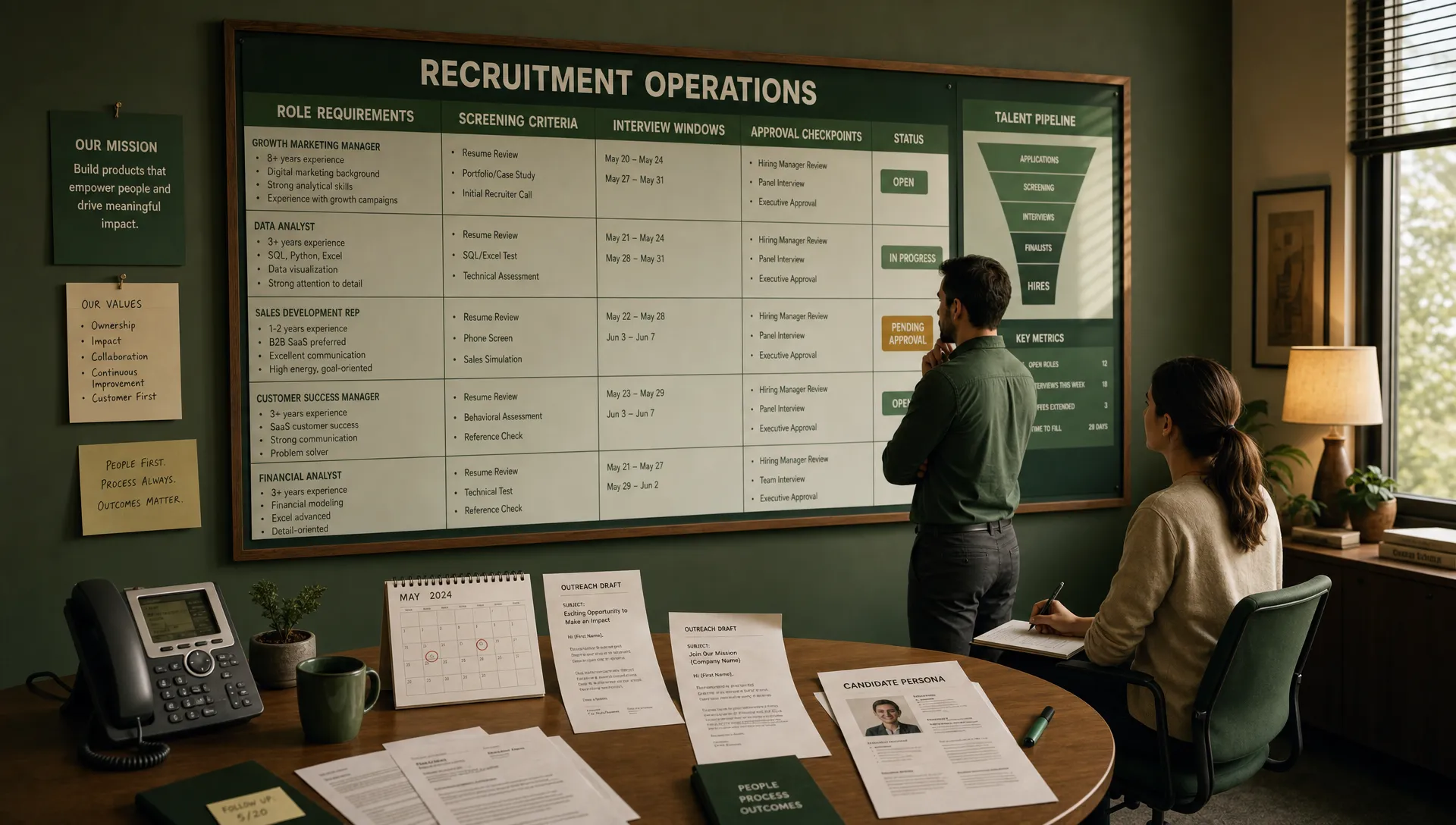
ChatGPT can help recruiters move faster, but it should never become an unreviewed hiring decision maker. The most effective teams use ChatGPT for recruiting as a structured assistant for intake, research, drafting, summarization, and consistency checks. Recruiters still own judgment, candidate experience, compliance, and final recommendations.
That distinction matters. A loose prompt can produce confident but unsupported rankings, generic outreach, or biased assumptions. A well-designed workflow can save hours while making your process more transparent. The goal is not to ask ChatGPT who to hire. The goal is to use it to clarify requirements, organize evidence, improve communication, and reduce repetitive work.
What ChatGPT should and should not do in recruiting
ChatGPT is strongest when it works with structured inputs and clear boundaries. It is weakest when asked to make high-stakes judgments from incomplete data or private candidate information without controls.
| Recruiting activity | Useful ChatGPT support | What should stay human owned |
|---|---|---|
| Intake | Turn a brief into questions, criteria, and a draft scorecard | Final role requirements and client or hiring manager alignment |
| Screening | Summarize evidence against stated criteria | Pass, reject, or advance decisions |
| Outreach | Draft personalized messages and follow-ups | Approval, tone, claims, and candidate relationship management |
| Interview prep | Generate structured questions and evaluation rubrics | Interview judgment and feedback calibration |
| Notes and summaries | Convert notes into concise updates | Accuracy review and ATS record ownership |
| Process improvement | Identify bottlenecks and inconsistent criteria | Policy decisions, compliance, and accountability |
A helpful rule is simple: ChatGPT can draft, structure, compare, and summarize. It should not independently decide, infer sensitive traits, or contact candidates without review.
Start with guardrails before you write prompts
Most bad AI recruiting outcomes start before the first prompt. If the role is vague, the must-have criteria are inconsistent, or the hiring manager changes priorities mid-process, ChatGPT will amplify that confusion.
Before using it in a live search, define the operating rules:
- The job outcome, not just the job title
- Must-have qualifications and how they will be evidenced
- Nice-to-have skills that should not unfairly exclude candidates
- Deal breakers that are job-related and defensible
- Interview stages and decision owners
- Privacy rules for candidate data
- The tone and messaging standards for outreach
- The human approval points in the workflow
This is where AI helps most when paired with disciplined recruiting operations. If your team is still defining approval boundaries, scorecards, and candidate communication standards, CandiDesk's guide to AI hiring best practices is a useful companion to this workflow.
A practical workflow for using ChatGPT in recruiting
The right workflow depends on whether you are an agency recruiter, an internal talent team, or a hiring manager. Still, the pattern is similar: structure the role, create criteria, draft messages, support interviews, then update the pipeline.
Turn the job brief into a sharper intake
Many searches slow down because intake is incomplete. ChatGPT can review a brief and identify missing information before recruiters spend days sourcing against assumptions.
You are helping a recruiter prepare intake questions for a new role.

Role: [job title]
Company context: [non-confidential company context]
Brief: [paste non-confidential job brief]

Create:
1. A summary of the role outcome in plain English
2. Must-have criteria that are directly supported by the brief
3. Nice-to-have criteria that should not be treated as requirements
4. Clarifying questions for the hiring manager
5. Potential risks if the search begins with this brief unchanged

Do not invent requirements. Flag any unclear points.
The value here is not that ChatGPT knows the role better than the recruiter. The value is that it forces ambiguity into the open. That makes hiring manager conversations more specific and reduces rework later.
Build an evidence-based scorecard
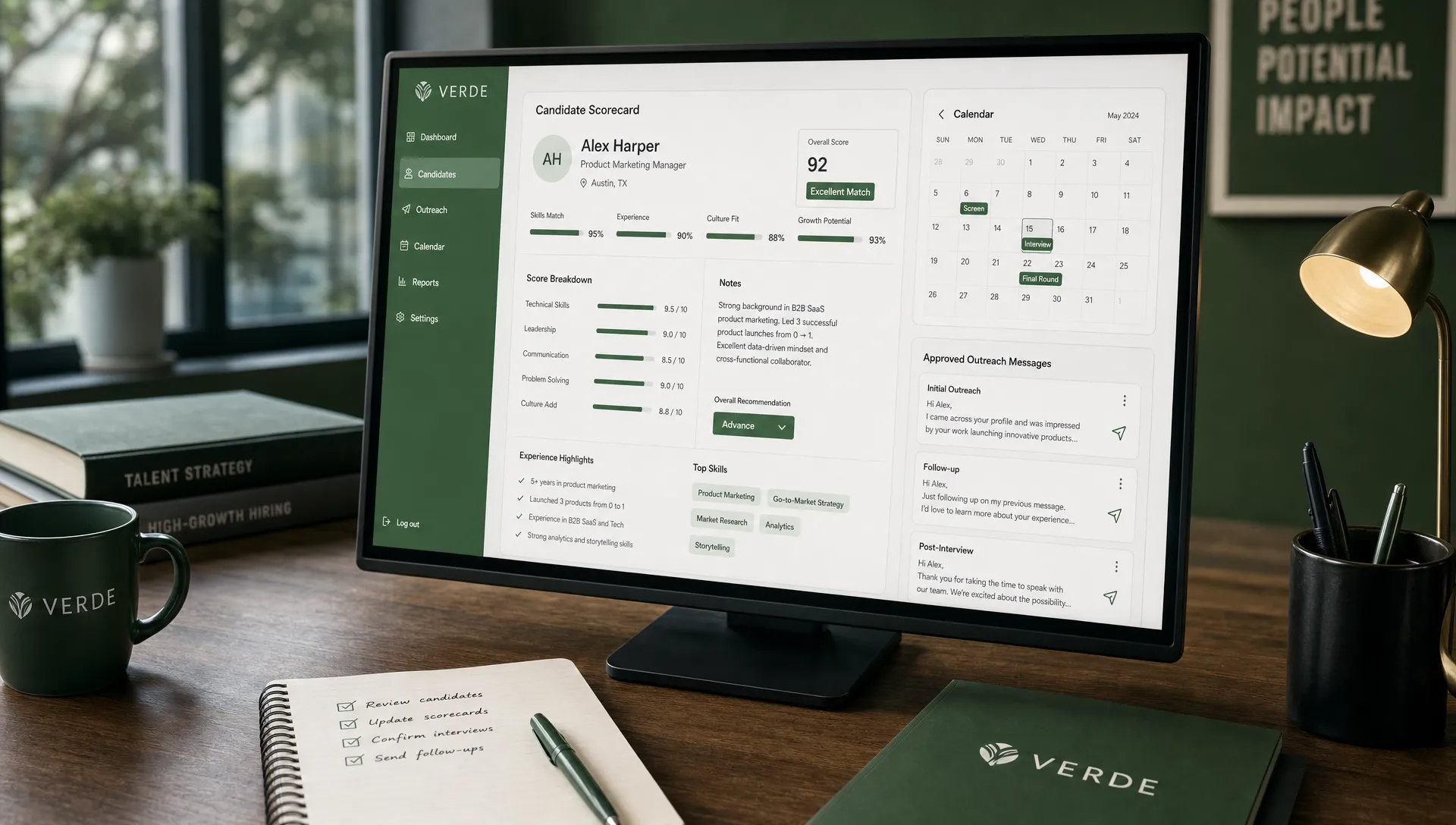
A scorecard makes AI-assisted recruiting safer because it gives the model a fixed structure. Instead of asking for a general opinion, ask ChatGPT to map evidence to criteria.
Using the role requirements below, create a candidate scorecard.

Requirements: [paste approved requirements]

For each criterion, include:
- What evidence would support it
- What evidence would be weak or insufficient
- A suggested 1 to 5 rating scale
- Interview questions that can validate it

Keep the criteria job-related and avoid protected characteristics or proxies for them.
This is also useful for agencies because it creates a shared language between recruiter, client, and sourcer. When everyone agrees on what good evidence looks like, shortlists become easier to defend.
Screen candidate information without turning AI into the decision maker
ChatGPT can help summarize resumes, profiles, or recruiter notes, but sensitive data requires caution. Do not paste candidate data into public tools unless your company policy, candidate consent model, and vendor terms allow it. When possible, remove unnecessary personal details and use systems with appropriate privacy controls.
A safer prompt focuses on evidence, uncertainty, and review:
Compare this candidate information against the approved scorecard.

Scorecard: [paste criteria]
Candidate information: [paste approved, policy-compliant information]

Return:
1. Evidence that supports each criterion
2. Evidence that is missing or unclear
3. Questions a recruiter should ask before making a recommendation
4. A brief recruiter-facing summary

Do not make a final hire, reject, or advance decision. Do not infer age, gender, ethnicity, health, family status, nationality, or other protected traits.
The output should be a starting point for recruiter review. If ChatGPT cannot cite evidence from the candidate information, the recruiter should treat that section as unsupported.
Draft outreach that sounds human and specific
Generic AI outreach is easy to spot. Good AI-assisted outreach is concise, accurate, and based on real relevance. ChatGPT can create first drafts, follow-ups, and variant messages, but recruiters should approve every message before it goes out.
Draft a candidate outreach message for this role.

Role: [job title]
Why the candidate may be relevant: [specific, verified evidence]
Tone: professional, concise, warm
Constraints: no exaggerated claims, no pressure tactics, no salary promise unless provided
Call to action: ask whether they are open to a short conversation

Create one email and one LinkedIn message. Keep both under 120 words.
This is especially helpful when recruiters handle multiple roles across regions or languages. The recruiter provides the relationship judgment, while AI reduces the time spent staring at a blank page.
Prepare interviews and feedback summaries
ChatGPT can generate structured interview questions from a scorecard, convert messy notes into clean summaries, and draft hiring manager updates. The recruiter still needs to verify accuracy and remove unsupported conclusions.
For interview prep, ask for questions that test job-related evidence rather than personality shortcuts. For summaries, ask the model to separate facts from impressions. That simple separation can reduce overconfidence and make debriefs more productive.
Prompting rules that protect quality
Recruiting prompts should be specific, constrained, and evidence-led. If you ask a broad question, you will get a broad answer. If you require citations from the input, uncertainty flags, and recruiter review, you get something much more useful.
Use these rules as your baseline:
- Give the model the role context, scorecard, and intended audience
- Ask it to separate evidence from assumptions
- Require it to flag missing information instead of filling gaps
- Tell it what not to consider, including protected traits and irrelevant proxies
- Use human approval for outreach, shortlist summaries, and next steps
- Keep a record of prompts and outputs when they influence recruiting work
One of the best prompt phrases is: Do not infer. Another is: cite only evidence from the provided material. Those instructions help reduce hallucination and make the output easier to audit.
Privacy, bias, and compliance considerations
Recruiting is a high-trust workflow. Candidates share personal data, companies make employment decisions, and regulators increasingly expect employers to understand how AI tools are used.
In the United States, the EEOC has warned that employers can be responsible if algorithmic tools create discriminatory outcomes. In the EU, GDPR already affects how personal data is processed, and the EU AI Act treats many employment-related AI systems as high-risk, with obligations phasing in. This is not legal advice, but it is a clear signal: recruiting teams need documented controls.
Practical safeguards include using only approved tools, minimizing candidate data, documenting human review, and testing for inconsistent outcomes. Teams should also be careful with proxies. Graduation year, commute distance, employment gaps, language patterns, and school names can all introduce unfair assumptions if used carelessly.
Candidate experience matters too. If AI drafts a message, the candidate should still receive accurate information, realistic timelines, and a clear path to a human recruiter. Automation should make communication faster, not colder.
Where general ChatGPT stops and a recruiting platform begins
ChatGPT is a flexible text assistant. It is not, by itself, a recruiting operating system. It does not automatically enforce your intake rules, sync with your ATS, book interviews, update pipeline stages, or maintain a human approval workflow unless you connect it to a broader process.
That is why many teams start with ad hoc prompting, then move toward dedicated AI recruitment software once they know where the value is. If the use case affects candidate experience, compliance, reporting, or pipeline operations, the workflow needs more structure than a chat window.
For example, CandiDesk is built for agencies and HR teams that want AI support across intake, candidate screening, outreach drafting, scheduling, pipeline updates, and recruiter-controlled communication. The key difference is workflow control. Candidate scoring should be evidence-based, messages should be approved by humans, and scheduling or pipeline updates should fit the tools recruiters already use.
If you are comparing options, focus less on feature volume and more on operational fit. This guide on what to look for in AI recruitment software explains the criteria that matter most, including structured intake, evidence-based scoring, integrations, and human review.
AI adoption also has a budget side. If your recruiting operation depends on Salesforce as a CRM layer, it is worth reviewing license use before buying more tools. Specialist support for Salesforce renewal and SKU reviews can help procurement and RevOps teams find shelfware and strengthen renewal readiness, while recruiters focus on workflow fit.
How to measure whether ChatGPT is helping
Do not measure AI recruiting success by speed alone. Faster bad decisions are still bad decisions. The better question is whether the team is becoming faster, more consistent, and more candidate-centered without losing recruiter control.
| Metric | What to compare | Why it matters |
|---|---|---|
| Intake completeness | Briefs before and after AI-assisted intake | Better intake reduces rework and misaligned shortlists |
| Time to first qualified outreach | Manual drafting versus AI-assisted drafting | Shows whether AI reduces repetitive writing time |
| Recruiter review time | Time spent editing AI outputs | Reveals whether prompts are improving or creating cleanup work |
| Candidate response quality | Replies, positive responses, and objections | Measures whether outreach is relevant, not just faster |
| Screening consistency | Scorecard evidence across recruiters | Helps identify uneven interpretation of criteria |
| Interview scheduling speed | Time from interest to booked interview | Shows operational impact on candidate momentum |
| Hiring manager feedback | Shortlist acceptance and revision requests | Indicates whether AI-assisted screening aligns with expectations |
A simple pilot can run for one role family or one client segment. Compare two to four weeks of baseline activity with an AI-assisted period. Review outputs weekly, improve prompts, and document what recruiters are allowed to automate.
Common mistakes to avoid
The most common mistake is using ChatGPT as a shortcut around intake. If the hiring manager has not agreed on the role criteria, AI will not fix the search. It may simply make the wrong search move faster.
Another mistake is asking for rankings without evidence. Rankings feel efficient, but they can hide weak reasoning. A better output is a structured summary showing where each candidate does or does not meet the agreed criteria.
Recruiters should also avoid over-personalization. AI can create messages that sound tailored but include assumptions the candidate never shared. Personalization should be based on verified professional relevance, not guesses about motivation, background, or personal circumstances.
Finally, do not let prompts become tribal knowledge. If one recruiter has a great prompt and another is improvising, the team will get uneven results. Maintain a small shared prompt library, review it regularly, and update it when roles, markets, or compliance expectations change.
Frequently Asked Questions
Can ChatGPT screen resumes for recruiters? Yes, it can help summarize resume evidence against a defined scorecard, but it should not make final pass or reject decisions. Recruiters should verify the output and ensure candidate data is handled according to company policy and applicable law.
Is it safe to paste candidate data into ChatGPT? Only if your organization has approved that use, the vendor terms meet your privacy requirements, and you are not sharing unnecessary personal data. Many teams prefer enterprise controls or recruiting platforms with privacy-focused workflows.
What is the best recruiting prompt for ChatGPT? The best prompt includes the role context, approved scorecard, task, output format, and clear limits. It should ask for evidence from the provided material and require the model to flag missing information instead of guessing.
Can ChatGPT write candidate outreach messages? Yes. It is useful for first drafts, follow-ups, tone variations, and multilingual outreach drafts. A recruiter should still approve every message before it is sent to ensure accuracy, relevance, and a good candidate experience.
Does ChatGPT replace an ATS or recruiting platform? No. ChatGPT can assist with text-based tasks, but an ATS or AI recruitment platform is needed for structured workflows, integrations, scheduling, pipeline updates, approvals, and record keeping.
Bring AI into recruiting without losing control
The right way to use ChatGPT for recruiting is to combine structured prompts with human judgment, privacy safeguards, and clear workflow ownership. Used well, it can improve intake, screening consistency, outreach quality, and recruiter productivity. Used casually, it can create risk and noise.
If your team is ready to move beyond isolated prompts, CandiDesk helps agencies and HR teams use AI across intake, candidate scoring with evidence, outreach drafting, interview scheduling, pipeline updates, and recruiter-approved communication, all while keeping humans in control.

Nikon Mazur
Nikon is a recruiting technology specialist with over five years of hands on experience building HR and hiring software, and the co founder of CandiDesk.
LinkedIn Profile