
hire tech talent
How to Hire Tech Talent in a Competitive Market

Hiring engineers, data specialists, product-minded developers, cybersecurity analysts, and AI practitioners is not getting simpler in 2026. Demand remains strong in the roles that help companies build, secure, automate, and scale digital products. The U.S. Bureau of Labor Statistics projects software developer, quality assurance analyst, and tester employment to grow 17% from 2023 to 2033, much faster than the average for all occupations.
That does not mean every company must outspend the market to hire tech talent. It means hiring teams need a sharper system. In competitive markets, the winners are usually not the teams with the longest interview process, the broadest job description, or the most generic outreach. They are the teams that define the role clearly, move quickly, evaluate fairly, and give candidates enough confidence to say yes.
Below is a practical playbook for agencies and HR teams that need to hire tech talent without compromising quality.
Start with a precise hiring intake
Many failed tech searches begin before sourcing starts. A hiring manager asks for a “senior full-stack engineer,” the recruiter posts a job, and three weeks later everyone realizes they disagree on what “senior” or “full-stack” actually means.
A strong intake should translate the business problem into evidence recruiters can use. Instead of starting with a list of technologies, start with outcomes.
Ask questions like:
- What will this person be expected to deliver in the first 90 days?
- Which technical skills are truly required on day one?
- Which skills can be learned after joining?
- What tradeoffs are acceptable, such as less domain experience but stronger architecture skills?
- What would make a candidate a “no” even if their resume looks impressive?
For example, “React, Node.js, AWS, startup experience” is not enough. “Own the rebuild of our customer onboarding flow, reduce page load issues, integrate with our existing Node services, and collaborate with product twice per week” gives recruiters a real target.
This is especially important when hiring for AI, data, security, platform engineering, or niche infrastructure roles. The difference between “has Python” and “has shipped production-grade ML pipelines with monitoring and rollback processes” is the difference between a crowded funnel and a useful one.
Build a role profile candidates can trust
Competitive tech candidates evaluate opportunities quickly. They want to know whether the role is real, whether the team understands the problem, and whether the company can make decisions without wasting their time.
A high-performing job brief should include more than a list of requirements. It should explain the work, the environment, and the decision criteria.
| Role element | Weak version | Stronger version |
|---|---|---|
| Technical scope | “Work on our platform” | “Improve our API reliability and reduce incident volume across payment workflows” |
| Seniority | “5+ years required” | “Able to lead design discussions, review tradeoffs, and mentor two mid-level engineers” |
| Tech stack | “Modern JavaScript stack” | “TypeScript, React, Node.js, PostgreSQL, AWS, with legacy services being migrated over 12 months” |
| Success measure | “Deliver high-quality code” | “Ship features safely, improve test coverage, and reduce support escalations tied to onboarding” |
| Hiring process | “Several interview stages” | “Recruiter screen, technical discussion, practical exercise, final team conversation” |
Clarity helps in two ways. It attracts candidates who are genuinely aligned, and it gives recruiters a consistent basis for screening. It also reduces rework because hiring managers are less likely to reject candidates for unstated preferences.
Compete on speed, not just salary
Compensation matters, especially in hard-to-fill technical roles. But salary is not the only lever. Many candidates will disengage if the process is slow, unclear, or repetitive, even when the offer is strong.
Speed does not mean rushing. It means removing avoidable delay.
A competitive process usually has clear service levels. Recruiters should know how quickly to review new applicants, when to follow up after outreach replies, and how soon hiring managers must provide feedback. Interview slots should be protected before candidates enter the process, not found after a promising screen.
For agencies, speed also depends on client alignment. If a client takes a week to review each shortlist, top candidates may already be gone. Set expectations early: competitive tech searches need same-day or next-day feedback whenever possible.
This is where automation can help without replacing human judgment. Scheduling, reminders, pipeline updates, and structured screening summaries should not drain recruiter time. If you want to explore how this looks in practice, CandiDesk has covered how AI in recruitment helps teams hire faster while keeping recruiters in control.
Source where technical candidates actually spend attention
Posting on major job boards can still work, but relying only on inbound applications is risky for competitive roles. Strong tech candidates are often employed, selectively open, or only responsive when the opportunity feels relevant.
The best sourcing strategy combines several channels:
- Referrals from engineers, product leaders, and former colleagues
- Talent communities, open source networks, and specialist Slack or Discord groups
- LinkedIn and GitHub research, used thoughtfully and respectfully
- Alumni networks from companies with similar technical environments
- Past silver medalist candidates who were strong but not hired for a previous role
- Search-optimized career pages for niche or location-specific roles
That last point is often overlooked. If candidates search for specific roles, stacks, or local opportunities, your job pages and employer content need to be discoverable. For companies that depend on inbound search visibility, especially in regional markets, working with a specialist such as an SEO agency focused on local and technical search visibility can support the broader hiring engine by helping the right candidates find you earlier.
Sourcing also needs personalization. A senior backend engineer does not need a message saying, “I saw your impressive profile.” They need to know why this role matches their experience. Mention the system they have built, the scale they have handled, the problem your team is solving, and the decision timeline.
Screen for evidence, not resume decoration
Tech resumes are noisy. Some candidates understate excellent work. Others list every framework they have touched once. Keyword matching can be useful for filtering, but it should never be the entire screening method.
Evidence-based screening looks for proof that a candidate has solved problems similar to the one you are hiring for. That evidence might come from shipped products, architecture decisions, incident ownership, open source contributions, technical writing, prior team leadership, or structured responses in a screening call.
A better screening framework might evaluate:
- Problem relevance, meaning how closely their past work matches the role outcomes
- Technical depth, meaning whether they can explain tradeoffs, constraints, and failure modes
- Collaboration style, meaning how they work with product, design, security, or customer-facing teams
- Ownership level, meaning whether they executed tickets, led projects, or shaped strategy
- Learning agility, meaning how they handle unfamiliar systems or changing requirements
AI can help recruiters organize this evidence, but it must be used carefully. Candidate scoring should be explainable, grounded in role criteria, and reviewed by a human. For a deeper look at responsible workflows, see these AI hiring best practices for agencies and HR teams.
Design technical interviews that respect candidate time
Many companies lose strong candidates during the assessment stage. The issue is not that candidates dislike being evaluated. It is that they dislike vague, excessive, or irrelevant evaluation.
A good technical interview should reflect the actual job. If the role involves system design, assess system design. If it involves debugging production issues, include a debugging scenario. If it requires cross-functional collaboration, evaluate how the candidate communicates tradeoffs to non-engineers.
Be cautious with long take-home assignments. They may produce useful signal, but they can also exclude candidates with caregiving responsibilities, demanding current jobs, or multiple active processes. If you use a take-home, keep it time-boxed, explain the expected effort, and tell candidates how it will be evaluated.
Live coding can work for some roles, but it should not become a performance test unrelated to the day-to-day work. Pairing-style discussions, code review exercises, architecture walkthroughs, and practical debugging tasks often create a better signal for experienced candidates.
Give hiring managers a decision framework
Recruiters can build an excellent funnel and still lose momentum if hiring managers do not make consistent decisions. In competitive tech hiring, “I just want to see more people” is expensive. It delays offers, weakens candidate trust, and often reflects unclear criteria rather than a weak market.
Before interviews begin, define what each stage is meant to prove. A recruiter screen might validate motivation, compensation alignment, communication, and basic role fit. A technical conversation might assess depth in the required stack. A practical exercise might test problem solving. A final conversation might confirm values, collaboration, and mutual expectations.
Each interviewer should submit feedback against the same rubric. Avoid unstructured reactions such as “not senior enough” unless the interviewer explains what evidence was missing. Did the candidate fail to identify scalability risks? Did they need too much prompting? Did they lack experience leading design decisions? Specific feedback improves both hiring quality and recruiter calibration.
Sell the opportunity throughout the process
Hiring tech talent is not only a selection process. It is also a persuasion process.
Many companies wait until the offer stage to sell the role. By then, it may be too late. Candidates form opinions from the first outreach message, the clarity of the job brief, the speed of scheduling, the quality of interviews, and the way feedback is handled.
To compete with larger brands, smaller companies and agencies should emphasize advantages they can credibly offer:
- Direct ownership of meaningful technical problems
- Access to decision-makers and faster product cycles
- Modernization projects with visible business impact
- Strong engineering culture, not just a list of perks
- Flexible work models, if genuinely supported
- Clear growth paths for technical and leadership tracks
The key is honesty. Do not oversell a perfect engineering environment if the company is still improving its systems. Many candidates will accept technical debt if the team is transparent about priorities, investment, and decision-making authority.
Use AI to remove friction from the recruiting workflow
AI is most useful in tech recruiting when it improves consistency and gives recruiters more time for human work. It should not be used as a black box that rejects candidates without context.
In a competitive market, AI-supported workflows can help with:
- Turning client briefs or hiring manager notes into structured intake criteria
- Drafting personalized outreach for recruiter approval
- Summarizing screening calls and candidate evidence
- Coordinating interview scheduling across calendars
- Keeping ATS and CRM pipelines updated
- Supporting multi-language communication for international searches
CandiDesk is built around this recruiter-controlled model. It can support intake, candidate screening, outreach drafting, scheduling, and pipeline updates while keeping human approval in the loop before messages are sent. For agencies and HR teams managing multiple searches, that can reduce administrative drag without giving up accountability.
The point is not to automate relationships. The point is to protect recruiter time so they can build better relationships.
Make compensation conversations earlier and clearer
Avoiding compensation discussions rarely helps. If the range is misaligned, both sides lose time. If the range is competitive, sharing it early can increase trust.
Tech candidates also evaluate the full offer, not only base salary. Equity, bonus structure, remote work, learning budgets, equipment, on-call expectations, benefits, and career progression all shape the decision.
Recruiters should be prepared to explain:
- The compensation range and what determines level within it
- Whether the role is remote, hybrid, or office-based in practice
- How promotions and salary reviews work
- Any on-call expectations and how they are compensated
- The company’s approach to learning, conferences, certifications, or technical growth
If you cannot compete at the very top of the market, compete with clarity, speed, flexibility, and meaningful work. Many candidates value a well-run process because it signals how the company operates internally.
Track the metrics that reveal bottlenecks
You cannot improve tech hiring if you only track hires made. By the time a role is filled or lost, the most useful lessons may be hidden.
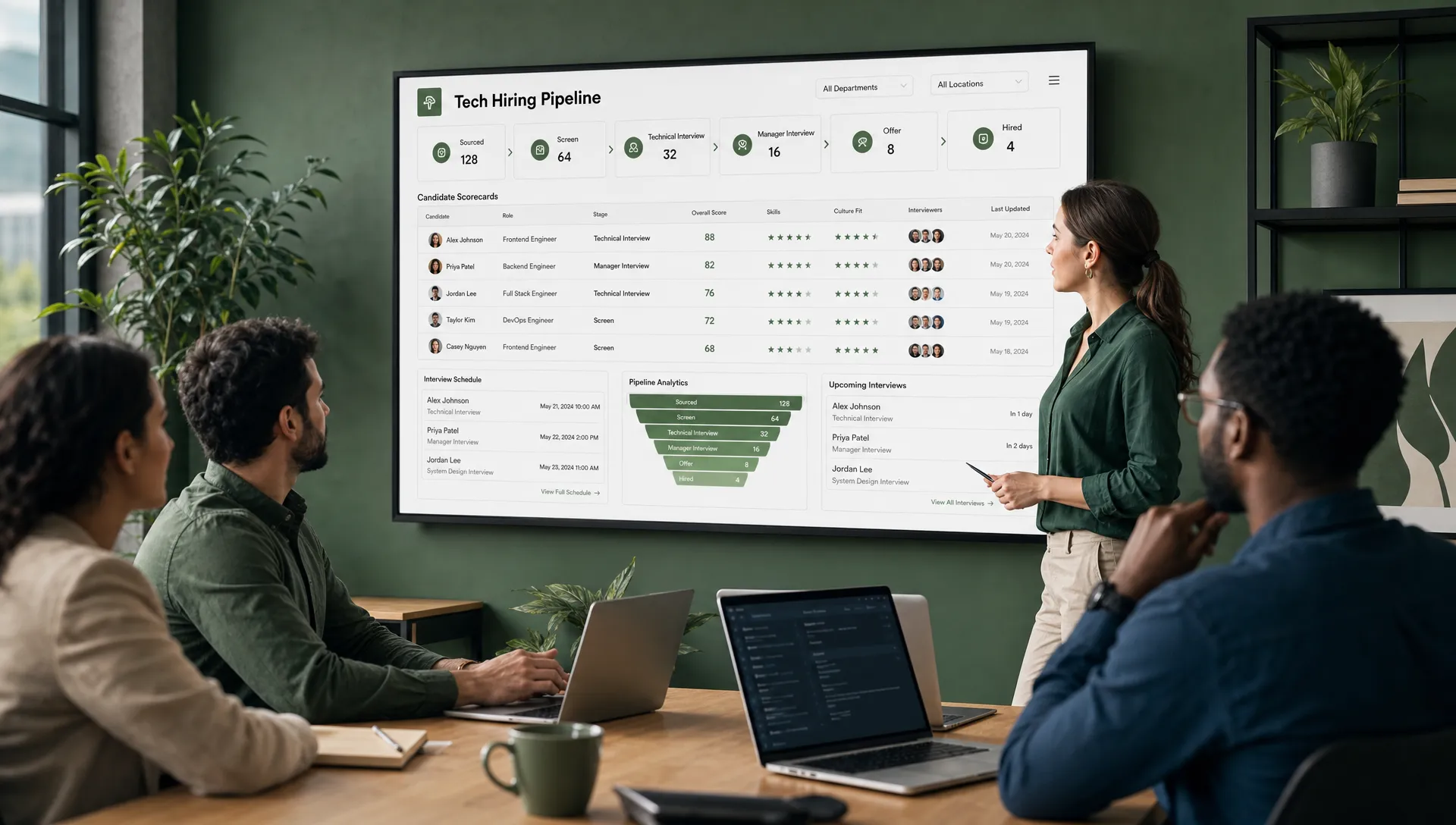
Track funnel metrics by role type, source, seniority, and hiring manager. This helps you understand whether the problem is sourcing volume, screening quality, interview conversion, offer competitiveness, or process speed.
| Metric | What it reveals | How to improve it |
|---|---|---|
| Qualified candidate rate | Whether sourcing matches the role criteria | Refine intake, source from more relevant pools, adjust outreach targeting |
| Response rate | Whether outreach is compelling | Personalize messages, clarify role value, test subject lines and timing |
| Screen-to-interview conversion | Whether screening criteria match hiring manager expectations | Recalibrate scorecards and review rejected profiles together |
| Interview feedback time | Whether the process is moving fast enough | Set feedback SLAs and automate reminders |
| Offer acceptance rate | Whether compensation, role fit, and candidate experience are competitive | Improve closing conversations and address concerns earlier |
| Time in stage | Where candidates are getting stuck | Remove unnecessary steps and pre-book interview availability |
Metrics should not be used to pressure recruiters into low-quality volume. They should help teams see friction clearly and fix the workflow.
Keep diversity and fairness central
Competitive hiring can create pressure to move fast, but speed should not come at the cost of fairness. Structured hiring protects both candidates and employers.
Use consistent criteria, ask comparable interview questions, document evidence, and challenge vague feedback. Expand sourcing beyond familiar networks. Review job descriptions for unnecessary requirements, such as degrees that are not actually needed or years of experience that do not reflect capability.
For AI-supported screening, fairness requires transparency and oversight. Recruiters and hiring managers should understand why a candidate is recommended, what evidence supports the recommendation, and where human review is required. This is especially important in regulated environments or cross-border hiring contexts where data handling and candidate rights matter.
Frequently Asked Questions
What is the fastest way to hire tech talent without lowering standards? The fastest way is to improve role clarity, pre-book interview capacity, use evidence-based screening, and automate administrative work such as scheduling and pipeline updates. Speed comes from removing delays, not skipping evaluation.
How do you attract passive tech candidates? Passive candidates respond to relevant, specific outreach. Show that you understand their background, explain the technical problem, clarify why the role is worth discussing, and make the process easy to enter.
Should companies use take-home technical tests? Take-home tests can be useful if they are short, role-relevant, and clearly evaluated. Long unpaid assignments often hurt candidate experience and may cause strong candidates to drop out.
How can smaller companies compete with big tech employers? Smaller companies can compete by offering ownership, faster decision-making, transparent leadership access, flexible work, and meaningful technical problems. They should also run a faster and more personal hiring process.
Can AI help hire tech talent fairly? Yes, if it is used to support structured intake, evidence organization, outreach drafting, scheduling, and recruiter review. AI should not be a black-box decision-maker. Human oversight and documented criteria remain essential.
Build a tech hiring process that candidates trust
To hire tech talent in a competitive market, you need more than a job post and a hopeful inbox. You need a system that defines the role clearly, reaches the right candidates, screens with evidence, moves quickly, and communicates with respect.
CandiDesk helps agencies and HR teams bring that system into their existing workflow with AI-assisted intake, screening, outreach drafting, scheduling, and pipeline updates, while keeping recruiters in control. If your team is ready to reduce manual work and improve hiring consistency, explore CandiDesk.

Nikon Mazur
Nikon is a recruiting technology specialist with over five years of hands on experience building HR and hiring software, and the co founder of CandiDesk.
LinkedIn Profile