
candidate assessment platform
How to Compare Candidate Assessment Platforms
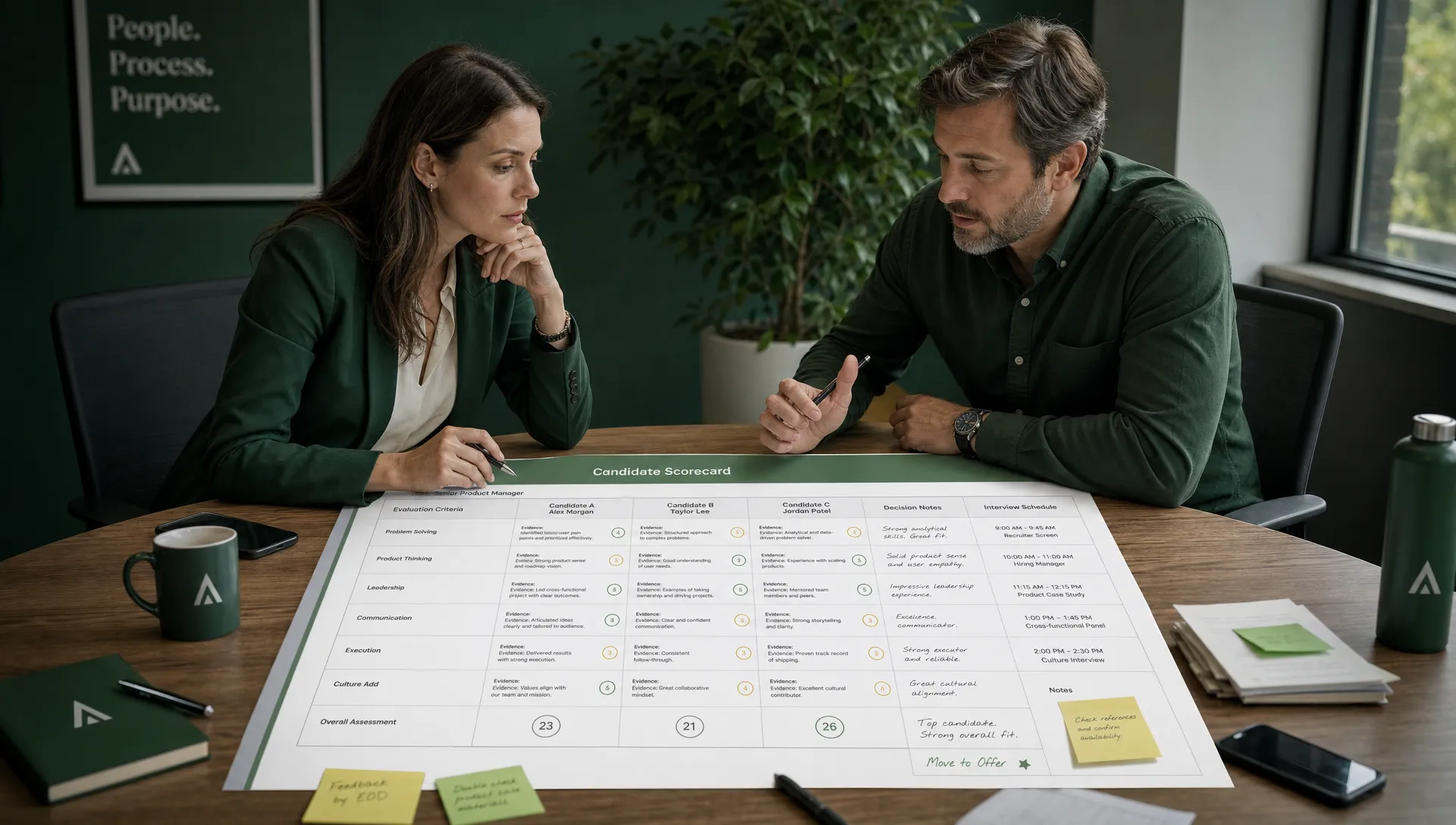
Comparing candidate assessment platforms is not just a feature checklist exercise. Most vendors can promise faster screening, better shortlists, and smarter scoring. The harder question is whether their assessments produce evidence your recruiters, hiring managers, and compliance stakeholders can trust.
A strong candidate assessment platform should help your team answer three practical questions: who is qualified, why are they qualified, and what should happen next. If the platform only gives you a rank without showing the reasoning behind it, you may move faster while making decisions that are harder to defend.
This guide gives you a practical framework for comparing platforms, running a meaningful pilot, and choosing a solution that improves hiring quality without taking control away from recruiters.
What a candidate assessment platform should actually do
A candidate assessment platform is any tool that helps evaluate applicants or sourced candidates against role requirements. Depending on the vendor, this can include knockout screening, skills tests, structured interview scoring, work simulations, psychometric assessments, AI-assisted screening, video interview analysis, or evidence-based candidate scorecards.
The best platforms do more than test people. They create a consistent decision workflow. That means translating the hiring brief into criteria, gathering role-relevant evidence, scoring candidates in a transparent way, and keeping records that explain each recommendation.
For agencies and HR teams, this matters because assessment is rarely isolated. A recruiter still needs to clarify the client brief, screen profiles, draft outreach, schedule interviews, update the ATS, and communicate with candidates. If assessment sits in a separate silo, the team may gain a score but lose time copying data between systems.
A useful comparison starts with this principle: the platform should improve the quality, speed, and consistency of hiring decisions, not simply add another step to the funnel.
Start with hiring decisions, not vendor demos
Before speaking to vendors, map the decisions your team makes during a typical hiring process. This prevents you from being distracted by impressive demo features that do not solve your real bottlenecks.
If you are also reviewing the broader recruiting stack, CandiDesk has a separate guide on how to choose a talent acquisition platform that starts from workflow pain points rather than software categories.
For candidate assessment specifically, define the decisions you want the platform to support:
| Hiring decision | Evidence you need | Platform capability to compare |
|---|---|---|
| Should this person move past initial screening? | Must-have skills, eligibility, availability, compensation fit | Structured screening questions and transparent knockout logic |
| How strong is the candidate against role requirements? | CV evidence, responses, work samples, interview notes | Evidence-based scoring and explainable recommendations |
| Who should be prioritized first? | Match strength, responsiveness, urgency, market scarcity | Candidate ranking with clear rationale and recruiter override |
| Is the process consistent across recruiters? | Shared criteria, standardized notes, comparable scorecards | Structured workflows, audit trails, and calibration tools |
| What should happen next? | Candidate stage, interview availability, communication history | ATS, CRM, calendar, and messaging integrations |
This exercise also helps you separate essential requirements from nice-to-have features. For example, a staffing agency handling high-volume roles may prioritize fast screening and scheduling automation. An executive search team may care more about evidence quality, structured interviews, verification, and stakeholder collaboration.
The core criteria for comparing candidate assessment platforms
1. Job relevance of the assessment method
The first question is whether the assessment reflects the work the candidate will actually do. Generic tests can be useful in some contexts, but they are weak substitutes for role-specific evidence.
For technical roles, this may mean practical exercises, code review, case tasks, or structured technical questions. For sales roles, it may mean prospecting scenarios, discovery call simulations, or evidence of quota performance. For leadership roles, it may mean structured interviews, strategic case discussions, and reference validation.
Ask vendors how assessments are configured for different roles, seniority levels, and industries. A good platform should support role-specific criteria rather than forcing every requisition through the same template.
2. Evidence-based scoring
A score is only useful if your team can understand it. When comparing platforms, look closely at how candidate scores are generated and presented.
A strong system should show the evidence behind each recommendation. That might include relevant CV excerpts, screening answers, interview notes, skill test results, or recruiter-approved observations. It should also show where evidence is missing, weak, or contradictory.
This is especially important when AI is involved. Recruiters should be able to inspect the reasoning, correct mistakes, and make the final decision. A black-box match score may look efficient, but it can create problems when a hiring manager asks, “Why did we reject this person?”
3. Bias controls and consistency
Candidate assessment platforms should make hiring more consistent, not more opaque. Ask how the platform helps teams apply the same criteria to every candidate in the same process.
Important controls include structured questions, consistent scoring rubrics, configurable criteria, audit trails, and the ability to review patterns across candidate groups. If a vendor claims to reduce bias, ask what that means in practical terms. Do they provide adverse impact reporting? Can you audit scoring logic? Can recruiters override or flag questionable recommendations?
No platform can remove bias on its own. The right goal is to support structured, documented, job-related decision-making with humans accountable for the outcome.
4. Candidate authenticity and verification support
Hiring teams are operating in a noisier talent market. AI-generated resumes, polished LinkedIn profiles, inflated metrics, and manufactured social proof can make traditional signals less reliable.
That does not mean every candidate should be treated with suspicion. It means assessment platforms should help recruiters collect better evidence before decisions are made. For senior and high-trust roles, this may include proof packs, structured interviews, work samples, reference checks, and proportionate verification. For a deeper view of this challenge, Optima Europe offers practical guidance on evidence-based vetting in a post-truth economy.
When comparing vendors, ask whether the platform helps you document claims, compare evidence across sources, and keep verification steps tied to the role’s risk level.
5. Human oversight and recruiter control
Automation should remove repetitive work, not remove professional judgment. This is particularly important in candidate assessment because decisions affect people’s employment opportunities.
Look for controls such as editable scoring criteria, recruiter review steps, approval workflows, and clear handoffs between AI suggestions and human decisions. If the system drafts candidate outreach or interview follow-ups, recruiters should be able to approve messages before they are sent.
The strongest platform will make recruiters faster while keeping them accountable. It should help them spend less time chasing information and more time evaluating fit, advising hiring managers, and building candidate relationships.
6. Candidate experience
Assessment quality drops when candidates abandon the process or feel the experience is unfair. Compare platforms from the candidate’s point of view, not only the recruiter’s dashboard.
Pay attention to completion time, mobile usability, accessibility, clarity of instructions, language options, and transparency about how responses will be used. For high-demand candidates, a long or generic test too early in the process can reduce conversion.
A useful rule is to match the assessment burden to the candidate’s stage and the role’s importance. Early screening should be lightweight. Deeper tasks should come after genuine mutual interest has been established.
7. Integrations with your recruiting workflow
A candidate assessment platform should not create another disconnected database. At minimum, compare how each vendor connects with your ATS, CRM, calendar, email, and communication tools.
For agencies, integration quality is particularly important because recruiters often manage multiple clients, roles, and pipelines at once. If assessment results do not sync back to the system of record, adoption will suffer. Recruiters will either duplicate work or avoid the tool entirely.
Ask vendors what data syncs, how often it syncs, and whether recruiters can trigger actions from inside their existing workflow.
8. Data privacy, security, and governance
Candidate data is sensitive. Assessment platforms may process resumes, call notes, interview transcripts, test results, compensation expectations, and personal contact details.
Compare vendors on data retention, access controls, audit logs, permissioning, subprocessors, regional hosting options, and GDPR-focused handling where relevant. If AI is used, ask whether your candidate data is used to train shared models and how the vendor manages consent, deletion, and data subject requests.
Security review should happen early, not after your team has already chosen a favorite platform.
A practical scorecard for comparing platforms
You can adapt the table below into a vendor evaluation scorecard. The weights are only a starting point. Change them based on your hiring volume, role complexity, legal environment, and candidate market.
| Evaluation area | Suggested weight | What strong platforms show | Red flags |
|---|---|---|---|
| Evidence quality | 25% | Scores linked to role-specific evidence, notes, answers, and work samples | Rankings with little or no explanation |
| Fairness and governance | 20% | Structured criteria, audit trails, review controls, consistent workflows | Unclear scoring logic or vague bias claims |
| Workflow fit | 20% | ATS, CRM, calendar, and communication sync with minimal manual work | Recruiters must copy results between systems |
| Candidate experience | 15% | Clear instructions, reasonable completion time, mobile-friendly flow | Long generic tests with poor transparency |
| Automation value | 10% | Automation reduces admin while keeping humans in control | AI actions happen without review or approval |
| Privacy and security | 10% | Clear data handling, access controls, retention policies, GDPR-aware processes | Weak answers on data use, retention, or model training |
A scorecard prevents vendor comparisons from becoming subjective. It also helps align recruiters, hiring managers, procurement, legal, and IT around the same decision criteria.
How to run a meaningful vendor pilot
A pilot should test the platform against real recruiting work. Do not rely only on a polished demo environment or a sample role created by the vendor.
Start with one or two representative requisitions. Choose roles that reflect your actual pain points, such as high applicant volume, poor screening consistency, slow interview scheduling, or hard-to-compare candidate profiles. If possible, include historical candidates whose outcomes are already known, then compare how the platform evaluates them.
Before the pilot begins, define what success looks like. Useful pilot metrics include:
- Recruiter time spent per screened candidate
- Percentage of candidates with complete assessment evidence
- Candidate completion and drop-off rates
- Agreement between platform recommendations and recruiter judgment
- Hiring manager satisfaction with shortlist quality
- Time from application or sourcing response to interview booking
- Quality and clarity of scorecards shared with stakeholders
Do not judge the pilot only by whether the platform “found” the same candidates your team liked. A good assessment tool may surface overlooked candidates or challenge assumptions. The more important test is whether it gives your team better evidence, improves consistency, and reduces manual work.

Questions to ask every vendor
The best vendor conversations are specific. Use questions that force the platform provider to explain how the system works in real hiring conditions.
| Topic | Ask this question | Why it matters |
|---|---|---|
| Scoring | What evidence is attached to each score or recommendation? | Recruiters need defensible reasoning, not just rankings |
| Configuration | Can we tailor criteria by role, client, seniority, and market? | Generic assessments can miss role-specific success factors |
| AI oversight | Which actions are automated, and which require human approval? | Teams need speed without losing accountability |
| Integrations | What data syncs with our ATS, CRM, calendar, and email tools? | Poor sync creates duplicate work and weak adoption |
| Candidate experience | How long does the assessment take, and what do candidates see? | Friction can reduce completion and damage employer brand |
| Privacy | How is candidate data stored, retained, deleted, and used by AI models? | Assessment data requires careful governance |
| Reporting | Can we analyze pass rates, drop-offs, recruiter overrides, and funnel outcomes? | Continuous improvement depends on visibility |
If a vendor cannot answer these questions clearly, that is useful information. Assessment platforms operate close to high-stakes hiring decisions, so vague answers should not be ignored.
Common mistakes when comparing candidate assessment platforms
One common mistake is buying the most sophisticated assessment engine while ignoring the workflow around it. Recruiters do not only assess candidates. They coordinate intake, outreach, follow-ups, interviews, feedback, and pipeline updates. If the platform does not fit that workflow, even a strong assessment model can fail in practice.
Another mistake is treating AI scores as decisions. AI can help organize information, draft summaries, and identify patterns, but hiring teams still need human review, calibration, and accountability. The question is not “Can the AI decide?” It is “Can the platform help our people make a better decision faster?”
Teams also over-assess candidates. Long tests, repeated questionnaires, and unclear instructions can push strong candidates out of the process. The assessment should be proportional to the role, the hiring stage, and the level of confidence you need.
Finally, many buyers wait too long to involve legal, compliance, security, or IT stakeholders. Candidate assessment touches privacy, fairness, system access, and data retention. Bringing these teams in late can delay implementation or force a rushed review.
Where CandiDesk fits in the comparison
Some organizations need a standalone testing tool. Others need assessment to be part of a broader recruiting workflow.
CandiDesk is designed for agencies and HR teams that want AI-assisted recruiting while keeping recruiters in control. It supports smart intake from client briefs, candidate scoring with evidence, AI chat and voice calls, human-approved outreach drafting, interview scheduling automation, pipeline and calendar sync, multi-language outreach, ATS and CRM integrations, and GDPR-focused data handling.
That makes it especially relevant when your assessment challenge is connected to operational bottlenecks. For example, if recruiters are spending too much time clarifying briefs, screening candidates, drafting messages, booking interviews, and updating records, assessment quality may improve only when the surrounding workflow improves too.
If you are comparing AI-enabled tools more broadly, this guide on what to look for in AI recruitment software can help you evaluate automation, human approval, integrations, and governance alongside assessment capabilities.
Frequently Asked Questions
What is a candidate assessment platform? A candidate assessment platform helps recruiters evaluate candidates using structured evidence such as screening answers, skills tests, work samples, interview notes, and scoring rubrics. Some platforms focus on testing only, while others connect assessment with outreach, scheduling, and pipeline management.
How should I compare candidate assessment platforms? Compare platforms by evidence quality, job relevance, explainability, bias controls, candidate experience, workflow integrations, automation value, and data governance. A practical scorecard is better than a generic feature checklist.
Are AI candidate assessment platforms safe to use? They can be useful when configured carefully, reviewed by humans, and governed properly. Teams should avoid black-box decision-making, use job-related criteria, monitor outcomes, and involve legal or compliance stakeholders where appropriate.
What metrics should I track during a platform pilot? Track recruiter time saved, assessment completion rates, candidate drop-off, shortlist quality, hiring manager satisfaction, scorecard clarity, interview booking speed, and how often recruiters agree or disagree with platform recommendations.
Should agencies choose a standalone assessment tool or an end-to-end recruiting platform? It depends on the bottleneck. If your only problem is a specific technical test, a standalone tool may be enough. If assessment is tied to intake, screening, outreach, scheduling, and pipeline updates, an integrated recruiting platform may deliver more operational value.
Compare platforms by the decisions they improve
The right candidate assessment platform should help your team make faster, fairer, and better-documented hiring decisions. It should also fit the way recruiters actually work.
If you want assessment, outreach, scheduling, and pipeline updates to work together with human oversight, explore how CandiDesk helps agencies and HR teams hire more consistently with AI-assisted recruiting workflows.

Nikon Mazur
Nikon is a recruiting technology specialist with over five years of hands on experience building HR and hiring software, and the co founder of CandiDesk.
LinkedIn Profile