
talent acquisition platform
How to Choose a Talent Acquisition Platform

Choosing a talent acquisition platform is not just a software purchase. It is a decision about how your team will intake roles, evaluate candidates, communicate with talent, schedule interviews, and keep hiring data consistent across systems.
The best platform for your organization is the one that removes bottlenecks without removing recruiter judgment. That matters even more in 2026, as hiring teams are expected to move faster, deliver a better candidate experience, and use AI responsibly across every stage of the funnel.
This guide walks through the practical criteria to use when comparing platforms, the questions to ask vendors, and the red flags that should make you pause before signing a contract.
Start with the workflow, not the feature list
A long feature checklist can make every vendor look similar. Before you compare demos, map the hiring workflow you actually need to improve.
For an agency, the biggest pain may be translating client briefs into consistent search criteria, screening large candidate pools, and keeping clients updated. For an internal HR team, the priority may be reducing time-to-schedule, improving hiring manager alignment, or standardizing candidate evaluation across departments.
A strong talent acquisition platform should support the full hiring motion, but your buying decision should begin with the highest-friction moments in your process. Ask where recruiters lose time, where candidates drop off, and where data becomes unreliable.
Common bottlenecks include:
- Intake calls that produce vague or inconsistent role requirements
- Manual screening that depends too heavily on keyword matching
- Outreach that takes too long to draft and personalize
- Interview scheduling that requires repeated back-and-forth messages
- Candidate updates that are not reflected in the ATS or CRM
- Hiring managers who lack clear evidence behind recommendations
Once you identify the real operational pain, it becomes much easier to separate must-have capabilities from impressive but unnecessary add-ons.
Understand what a talent acquisition platform should do
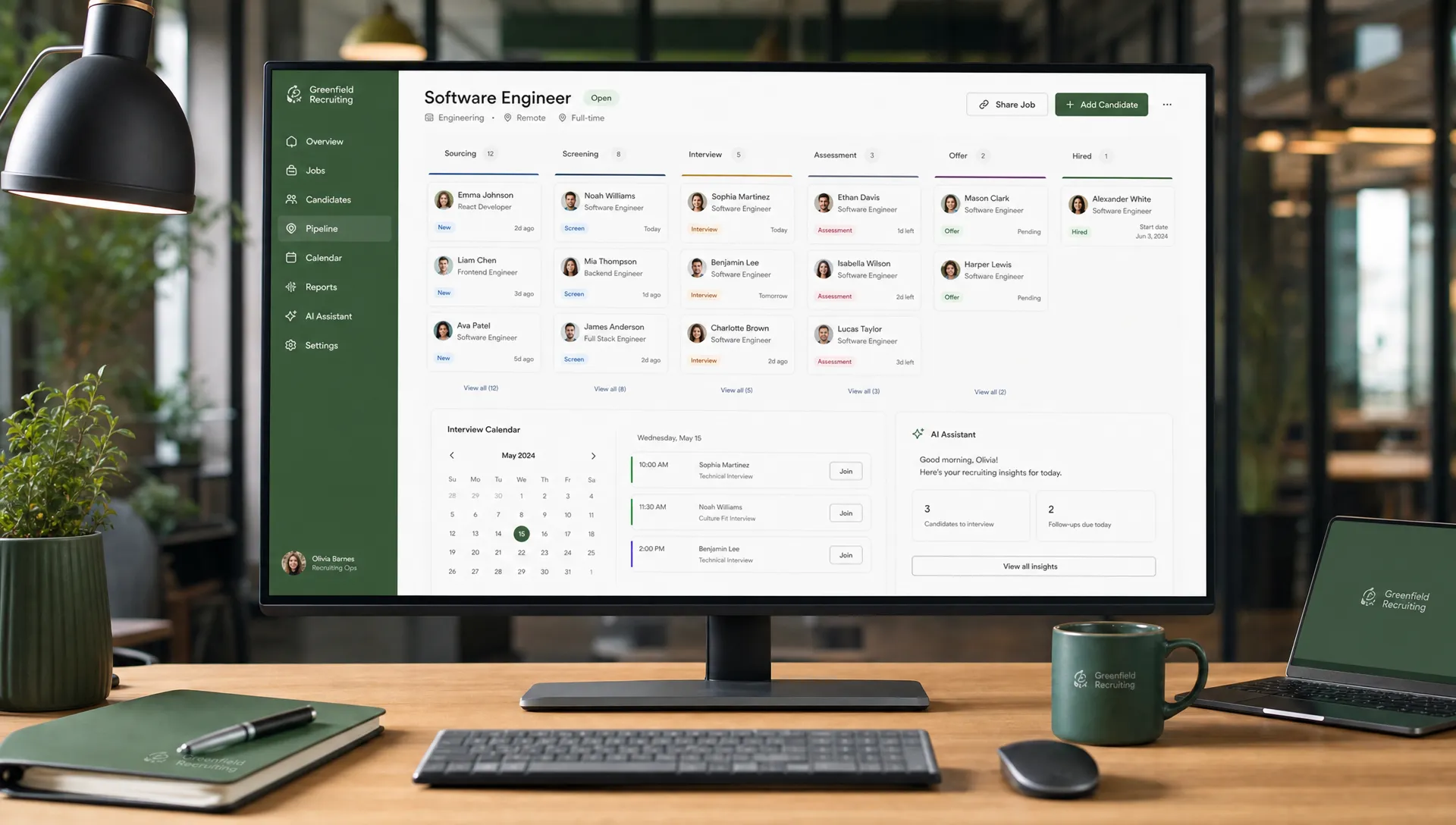
A talent acquisition platform usually sits around your ATS, CRM, sourcing tools, communication channels, and calendar systems. The ATS remains the system of record, while the platform helps teams execute and coordinate the work of hiring.
That distinction is important. You may not need to replace your ATS. In many cases, the better choice is to add a platform that improves speed, consistency, and candidate engagement while syncing with the tools your team already uses.
| Capability | Why it matters | What to verify |
|---|---|---|
| Intake support | Better role definition leads to better screening and outreach | Can the platform turn briefs into structured requirements? |
| Candidate screening | Recruiters need consistent, explainable shortlists | Does scoring include evidence, not just a black-box rating? |
| Outreach drafting | Personalized messages improve response quality | Can recruiters review and approve messages before sending? |
| Scheduling automation | Interview coordination is a major time sink | Does it sync with calendars and update the pipeline? |
| ATS and CRM integration | Duplicate data entry slows teams down | Does it work with your current systems and workflows? |
| Compliance controls | AI-assisted hiring needs oversight | Are permissions, audit trails, and data handling clear? |
If your team is specifically evaluating AI capabilities, it can also help to review a dedicated guide on what to look for in AI recruitment software, since AI features should be judged by transparency, control, and workflow fit rather than novelty.
Evaluate intake quality first
Poor intake creates downstream problems. If the role requirements are unclear, every later step becomes weaker: screening is less accurate, outreach sounds generic, and hiring managers reject candidates for reasons that were never captured upfront.
A good platform should help recruiters move from an unstructured client or hiring manager conversation to a clear profile. That includes must-have skills, preferred experience, compensation context, location requirements, interview process, deal breakers, and signals of strong fit.
When comparing platforms, ask how intake is captured and updated. Can the system structure information from client briefs? Can recruiters refine requirements after a hiring manager gives feedback? Does the intake data inform candidate scoring and outreach, or does it simply sit in a notes field?
For agencies and high-volume HR teams, this is often one of the highest-leverage areas. Better intake reduces rework and helps every recruiter on the team align around the same definition of quality.
Look for evidence-based candidate scoring
Candidate scoring can save time, but only if recruiters can understand why a candidate is recommended. A score without supporting evidence is difficult to trust and risky to defend.
When a platform ranks or screens candidates, it should show the signals behind the recommendation. For example, it may highlight relevant experience, required certifications, location alignment, seniority, or gaps that need follow-up. Recruiters should be able to inspect the reasoning and make the final decision.
Avoid treating AI scoring as a replacement for professional judgment. The stronger model is AI-assisted screening, where the platform does the first layer of organization and evidence gathering, while recruiters validate fit, context, and nuance.
This is also important from a governance perspective. The EEOC has published guidance reminding employers that algorithmic tools used in employment decisions can still create liability if they result in unlawful discrimination. Even if a vendor provides the technology, the employer remains responsible for how hiring decisions are made.
Prioritize human-approved communication
Fast outreach is valuable, but uncontrolled automation can damage candidate trust. A platform should help recruiters draft timely, personalized messages while keeping humans in control of what gets sent.
Look for a workflow where AI can prepare outreach, follow-ups, interview confirmations, or screening questions, but a recruiter can review and approve messages before they go out. This is especially important for executive searches, sensitive roles, agency-client relationships, and multilingual hiring.
Human approval also protects your employer brand. Candidates can usually tell when communication is generic or misaligned. The right platform should make recruiters faster without making communication feel careless.
CandiDesk, for example, is designed around human-approved outreach drafting, candidate screening with evidence, AI chat and voice calls, scheduling automation, and pipeline updates while keeping recruiters in control.
Check scheduling and pipeline automation carefully
Scheduling is one of the easiest areas to underestimate. It looks simple until you calculate the number of messages required to coordinate candidates, recruiters, hiring managers, clients, reschedules, time zones, and calendar conflicts.
A good talent acquisition platform should reduce that coordination load. At minimum, it should support interview booking, calendar sync, candidate reminders, and pipeline updates. For agencies, it should also help maintain visibility across client submissions and interview stages.
The key question is not just whether the platform can schedule interviews. It is whether scheduling activity is reflected in the systems your team already uses. If recruiters still need to manually update the ATS after every booked interview, you have only shifted the admin burden rather than removing it.
For a broader view of where automation has the biggest operational impact, CandiDesk also explains how AI in recruitment helps teams hire faster across intake, screening, outreach, scheduling, and pipeline updates.
Make integrations a core buying criterion
Recruiting teams rarely work in one tool. They may use an ATS, CRM, email, calendar, messaging apps, job boards, assessment tools, and reporting systems. If your talent acquisition platform does not integrate well, it can create more work than it removes.
During evaluation, ask vendors to show the exact integration flow rather than simply naming supported tools. You want to understand what data moves, when it syncs, who can edit it, and what happens if records conflict.
Important integration questions include:
- Does the platform integrate with our ATS, CRM, calendar, and communication tools?
- Is the sync one-way or two-way?
- Which fields are updated automatically?
- Can recruiters override or correct data when needed?
- How are duplicates, candidate ownership, and status changes handled?
- What implementation support is required from our internal team?
CandiDesk is built to integrate with existing ATS, CRM, and communication tools, which is especially useful for teams that want automation without replacing their core recruiting stack.
Review compliance, security, and AI governance
Recruiting involves sensitive personal data, so compliance cannot be an afterthought. At minimum, your evaluation should cover data retention, permissions, auditability, privacy practices, and how AI-assisted decisions are governed.
For organizations operating in or hiring from Europe, GDPR-focused data handling is especially important. Even outside the EU, many companies use GDPR principles as a benchmark for privacy, transparency, and data minimization.
AI governance is also becoming a standard part of vendor evaluation. The NIST AI Risk Management Framework is a useful reference for thinking about trustworthy AI through governance, measurement, risk management, and transparency.
When speaking with vendors, ask how candidate data is used, whether customer data trains shared models, how bias is monitored, and whether recruiters can review the evidence behind AI-generated recommendations. If a vendor cannot explain how its AI works at a practical level, that is a concern.
Use a simple evaluation scorecard
A scorecard helps prevent the loudest demo feature from dominating the decision. It also gives recruiters, talent leaders, IT, legal, and hiring managers a shared framework for comparison.
| Evaluation area | What strong looks like | Risk if weak |
|---|---|---|
| Workflow fit | Supports your actual hiring process | Recruiters work around the platform |
| Recruiter control | Humans approve key actions | Automation creates brand or compliance risk |
| Screening transparency | Scores include evidence | Teams cannot trust or defend recommendations |
| Candidate experience | Communication is timely and relevant | Candidates disengage or lose trust |
| Integrations | Data syncs with core systems | Manual updates and duplicate records persist |
| Implementation | Clear setup, training, and ownership | Adoption stalls after purchase |
| Compliance | Privacy, permissions, and audit trails are clear | Legal and operational risk increases |
You can weight these categories based on your team’s priorities. For example, an agency handling high-volume sourcing may weight screening, outreach, and CRM integration more heavily. An enterprise HR team may place more emphasis on governance, auditability, and stakeholder reporting.
Run a pilot with real hiring scenarios
A polished demo is useful, but it is not enough. The best way to evaluate a platform is to test it with real roles, real candidate profiles, and real recruiter workflows.
A practical pilot does not need to last months. It should be focused enough to reveal whether the platform can improve your process without creating friction.
Use these steps for a structured pilot:
- Select representative roles: Choose roles that reflect your normal hiring complexity, not only easy requisitions.
- Define success metrics: Track time saved, recruiter adoption, candidate response quality, scheduling speed, and hiring manager satisfaction.
- Test integrations: Confirm that records, notes, statuses, and calendar events sync correctly.
- Review AI outputs: Check whether screening evidence, outreach drafts, and suggested next steps are accurate and usable.
- Collect recruiter feedback: Ask recruiters where the platform helped, where it slowed them down, and what they would change before rollout.
The goal is not to prove that the tool can perform one isolated task. The goal is to see whether it improves the complete hiring workflow from intake to interview.
Watch for common red flags
Some platforms look impressive in a sales environment but fail in daily recruiting operations. Watch closely for signs that the product is either too rigid, too opaque, or too disconnected from your existing systems.
Red flags include:
- AI recommendations with no clear evidence or explanation
- Fully automated candidate communication with limited approval controls
- Weak or unclear ATS and CRM integration details
- Generic workflows that cannot reflect agency or internal hiring differences
- No clear answer on data privacy, retention, or model training practices
- Reporting that focuses on activity volume but not hiring outcomes
- Implementation plans that depend heavily on recruiter workarounds
If a vendor dismisses recruiter oversight as unnecessary, be cautious. In hiring, speed matters, but trust, fairness, and candidate experience matter just as much.
Match the platform to your team type
Different teams need different strengths. The right choice depends on your hiring volume, role complexity, compliance environment, and current tech stack.
Recruitment agencies often need stronger client intake, CRM sync, outreach support, multilingual communication, and pipeline visibility across many roles. Internal HR teams may prioritize hiring manager collaboration, ATS integration, compliance controls, and consistent interview scheduling.
High-growth teams may care most about speed and repeatability. Enterprise teams may need stronger governance and implementation support. Specialized recruiting teams may need deeper sourcing context and more nuanced screening evidence.
If you are still comparing categories and vendors, a shortlist like AI recruiting tools worth testing in 2026 can help you understand how different platforms position themselves and which use cases they serve best.
Frequently Asked Questions
What is a talent acquisition platform? A talent acquisition platform is software that helps recruiting teams manage and improve hiring workflows such as intake, screening, outreach, scheduling, and pipeline updates. It often works alongside an ATS rather than replacing it.
How is a talent acquisition platform different from an ATS? An ATS is usually the system of record for applications, candidate stages, and compliance documentation. A talent acquisition platform focuses more on workflow execution, automation, engagement, and coordination across hiring tools.
Should AI be a required feature in a talent acquisition platform? AI can be valuable when it reduces manual work, provides evidence-based screening, drafts recruiter-approved communication, and updates workflows. It should not replace recruiter judgment or operate without oversight.
What is the most important feature to evaluate first? Start with the bottleneck that most affects your hiring results. For many teams, that is intake quality, screening consistency, outreach speed, scheduling automation, or integration with the existing ATS and CRM.
How long should a platform pilot take? A focused pilot can often be run over a few active roles. The key is to use real workflows, define success metrics before testing, and include the recruiters who will use the platform every day.
Choose a platform that helps recruiters do better work
The right talent acquisition platform should make hiring faster, more consistent, and easier to manage without removing the human judgment that great recruiting depends on.
If your team wants AI-supported intake, evidence-based candidate screening, human-approved outreach, interview scheduling automation, pipeline sync, multilingual outreach support, and integrations with existing recruiting tools, CandiDesk is built for agencies and HR teams that want to hire more effectively while keeping recruiters in control.

Nikon Mazur
Nikon is a recruiting technology specialist with over five years of hands on experience building HR and hiring software, and the co founder of CandiDesk.
LinkedIn Profile