
diversity hiring
How Diversity Hiring Builds Stronger, More Equitable Teams

Diversity hiring is not a branding exercise or a shortcut around merit. It is a disciplined hiring approach that helps agencies and HR teams find qualified people across wider talent pools, evaluate them consistently and remove avoidable friction from the process. The goal is not to favor one candidate over another because of identity. The goal is to stop hidden preferences, narrow networks and inconsistent decisions from deciding who gets seen, interviewed and hired.
For hiring teams in 2026, that discipline matters. Talent shortages, hybrid work and global candidate pools have made old recruiting habits less reliable. Candidates also expect more transparency from employers, especially around selection criteria, communication and interview fairness. Stronger teams are built when recruiters can combine access, evidence and accountability without slowing every search to a crawl.
What diversity hiring really means in practice
A fair process starts before the first resume arrives. It begins with a clear definition of what the role truly requires, which skills can be learned on the job and which signals will be used to compare candidates. That matters because vague requirements tend to reward familiarity. A hiring manager may say they need someone who fits the team, but fit often becomes a proxy for background, communication style or previous employer prestige.
Done well, diversity hiring gives every qualified person a clearer path through the same evidence-based process. It also helps recruiters challenge assumptions during intake, such as requiring a degree when equivalent experience would work or asking for years of experience that do not match the complexity of the role.
Representation and equity are not the same thing
Representation describes who is present in the applicant pool, shortlist, interview panel or team. Equity describes whether people can move through the process with comparable access, clarity and respect. A company can attract a broad applicant pool and still lose strong candidates if screening is inconsistent, interviewers are untrained or scheduling delays affect people with caregiving responsibilities.
For that reason, diversity hiring has to be paired with equitable systems. A diverse slate is useful, but it is not the finish line. The stronger signal is whether the process gives qualified candidates a fair chance to show role-relevant strengths.
Why broader perspectives make teams stronger
Better problem solving, fewer blind spots
Teams make better decisions when members can test assumptions from different angles. A group with similar backgrounds may move quickly, but speed can hide blind spots. People may overlook product risks, customer needs or operational issues because nobody in the room has lived the problem being discussed.
A Harvard Business Review article explains that diverse teams can process facts more carefully because difference often pushes people to question their own assumptions. When diversity hiring expands the range of relevant experiences in a team, it can improve the quality of debate and reduce the risk of defaulting to the loudest or most familiar point of view.
A wider talent pool makes hiring more resilient
Recruiting teams that rely on the same schools, companies, referrals and platforms eventually compete for the same candidates as everyone else. That raises costs and narrows options. Widening sourcing channels helps teams discover qualified people who may not sit inside the usual networks but still bring the skills, learning ability and motivation the role requires.
McKinsey's 2023 analysis found that companies in the top quartile for gender and ethnic diversity in executive teams were more likely to outperform financially than those in the bottom quartile. The report does not mean representation alone guarantees performance. It does support a practical point for recruiters: inclusive talent systems belong in a serious growth strategy, not a side initiative.
How to build equity into the hiring funnel
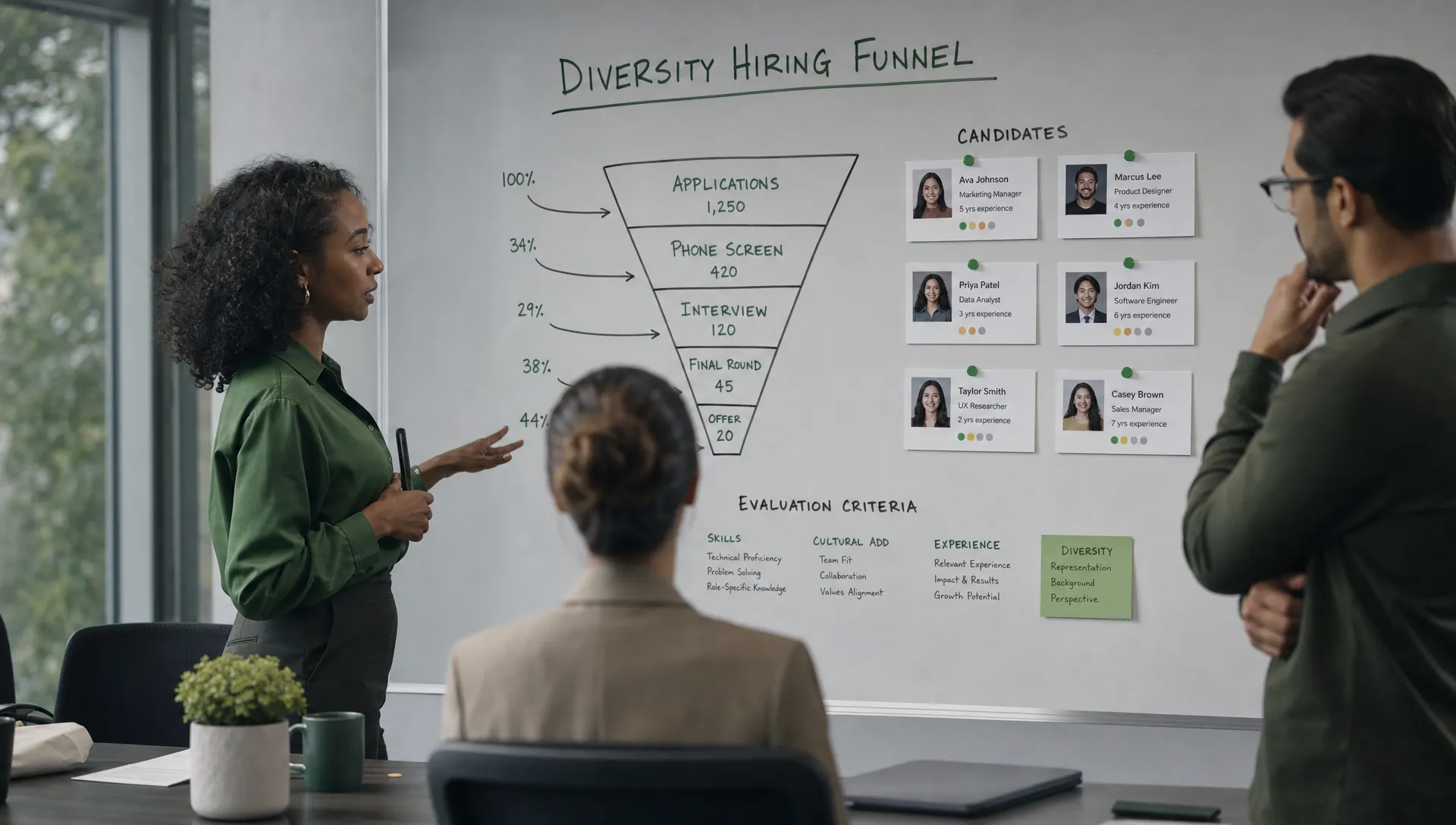
A practical diversity hiring plan makes the full funnel visible, from intake to offer acceptance. That visibility helps teams identify where bias or friction may enter the process and where simple changes can improve consistency.
| Hiring stage | Common equity risk | Better practice |
|---|---|---|
| Intake | Vague must-haves and recycled job criteria | Separate essential skills from preferences and agree on evidence before sourcing |
| Job description | Gendered language, inflated requirements or unclear salary context | Use plain language, role-relevant requirements and transparent expectations where possible |
| Sourcing | Overreliance on referrals or familiar networks | Use multiple channels and track which sources produce qualified candidates |
| Screening | Resume shortcuts based on school, company name or career gaps | Score candidates against role criteria with evidence from their experience |
| Interviews | Free-form questions that vary by interviewer | Use structured questions and consistent rubrics |
| Offers | Late-stage surprises around pay, flexibility or process | Communicate clearly and monitor acceptance patterns by candidate segment where legally appropriate |
Structured hiring may feel slower at first, but it prevents rework. When criteria are agreed early, recruiters spend less time debating subjective impressions after interviews. The same discipline applies when teams introduce automation. CandiDesk's guide to AI hiring best practices for agencies and HR teams explains why human approval, clear criteria and evidence-based scoring should stay central.
How AI can support fairer recruiting without taking control
AI should not become the decision-maker in a hiring process. Used poorly, it can scale inconsistent criteria or reproduce patterns from past hiring decisions. Used carefully, it can help recruiters apply agreed criteria more consistently, reduce administrative delays and keep every candidate moving through the same workflow.
In this context, diversity hiring benefits from AI when the technology standardizes repetitive steps while leaving judgment with trained humans. CandiDesk, for example, is built for agencies and HR teams to automate intake, candidate screening, outreach drafting, scheduling and pipeline updates while keeping recruiters in control. Its human-approved outreach model is especially relevant for teams that want speed without sending messages blindly.
The NIST AI Risk Management Framework is a useful reference for teams thinking about AI governance. It emphasizes validity, reliability, accountability, transparency and human oversight, all of which matter when AI touches employment workflows.
Where consistency helps most
Recruiters do a lot of work that affects candidate experience but does not require a fresh strategic decision every time. Those tasks are where automation can reduce uneven treatment.
- Intake: turn client briefs or hiring manager notes into structured criteria that can be reviewed before sourcing starts.
- Screening: compare resumes against agreed requirements and preserve evidence for each score.
- Outreach: draft clear candidate messages, including multilingual outreach where it fits the role and market.
- Scheduling: reduce delays that disproportionately affect candidates with limited availability.
- Pipeline updates: keep ATS, CRM and calendar data aligned so recruiters do not lose track of candidates.
For screening specifically, consistency is easier when recruiters can see why a candidate was advanced or rejected. This is why evidence matters more than a score alone. For a deeper look at that workflow, see how an AI tool for resume screening improves shortlists without removing recruiter accountability.
Safeguards that keep the process fair
Fair hiring systems need guardrails. Start with job-related criteria, document decisions and train interviewers to assess the same competencies. If a requirement does not predict success in the role, it should be challenged during intake rather than defended later as tradition.
Review diversity hiring outcomes by stage, not only at the final hire. If a broad applicant pool becomes a narrow interview slate, the issue may sit in screening. If interview slates are broad but offers are not, the issue may sit in interview scoring, compensation alignment or manager decision-making. Stage-by-stage review keeps the conversation specific and easier to fix.
In the United States, the EEOC Uniform Guidelines on Employee Selection Procedures describe the four-fifths rule as a practical indicator for adverse impact analysis, not as a final legal conclusion. Teams should work with legal counsel on compliance, especially when collecting demographic data or operating across jurisdictions.
Metrics that reveal whether the process is working
Measurement should help recruiters improve the system, not reduce people to dashboard categories. Where legally and ethically collected, demographic data can reveal patterns that would otherwise stay hidden. When that data is not available, teams can still track process quality through consistency, response times and candidate feedback.
| Metric | What it can reveal | How to use it responsibly |
|---|---|---|
| Applicant pool mix | Whether sourcing channels are too narrow | Compare channels and adjust outreach strategy |
| Pass-through rate by stage | Where qualified candidates may be dropping off | Review criteria, rubrics and reviewer behavior |
| Interview score variance | Whether interviewers apply standards consistently | Calibrate interview panels before decisions |
| Time in stage | Whether delays affect certain candidate groups | Automate scheduling and set response targets |
| Offer acceptance patterns | Whether compensation or flexibility is creating friction | Improve communication and align offers earlier |
| Candidate feedback | Whether the process feels respectful and clear | Use surveys and recruiter follow-up to find friction |
A healthy diversity hiring dashboard should combine quantitative patterns with qualitative review. Numbers can flag a possible problem, but the fix usually comes from reading examples, listening to candidate feedback and improving the workflow that produced the pattern.
Common mistakes that weaken equitable hiring
The first mistake is treating a diverse slate as the outcome. A slate can be diverse while the process still favors the candidate who attended a familiar university, worked at a fashionable company or communicates in the style the interviewer personally prefers.
The second mistake is using culture fit as a scoring category. Values alignment can matter, but culture fit often becomes a vague label for comfort. A better approach is to define specific behaviors, such as collaboration across functions, direct customer communication or ability to give and receive feedback.
The third mistake is collecting data without acting on it. If the team reviews funnel metrics quarterly but never changes sourcing, screening or interview behavior, measurement becomes performance theater. Diversity hiring should lead to process decisions that can be observed, tested and improved.
Frequently Asked Questions
What is the main goal of diversity hiring? Diversity hiring aims to widen access to qualified talent and make selection more consistent. It is not about lowering standards. It is about defining standards clearly and making sure every candidate is evaluated against role-relevant evidence.
How can recruiters avoid tokenism? Avoid tokenism by focusing on the full system rather than symbolic representation. Build broad sourcing channels, use structured screening, train interviewers and track whether candidates from different backgrounds move through the process fairly.
Can AI make hiring more equitable? AI can support fairness when it standardizes repetitive work, preserves evidence and keeps humans accountable for decisions. It can also create risk if teams use it without validation, oversight or clear criteria.
What should hiring teams measure first? Start with funnel stage data, source quality, time in stage, interview score consistency and candidate feedback. These measures show where friction appears and which fixes are most likely to improve the process.
Build a stronger, fairer hiring workflow
Equitable teams are built through repeated, practical choices: clearer intake, broader sourcing, consistent screening, structured interviews and timely candidate communication. None of those steps has to slow hiring down when the workflow is designed well.
CandiDesk helps agencies and HR teams automate intake, candidate screening, outreach drafting, interview scheduling and pipeline updates while keeping recruiters in control. If your team wants faster hiring with stronger evidence and human approval at the center, it is a practical place to start.

Nikon Mazur
Nikon is a recruiting technology specialist with over five years of hands on experience building HR and hiring software, and the co founder of CandiDesk.
LinkedIn Profile