
ai in recruitment
How AI in Recruitment Helps Teams Hire Faster
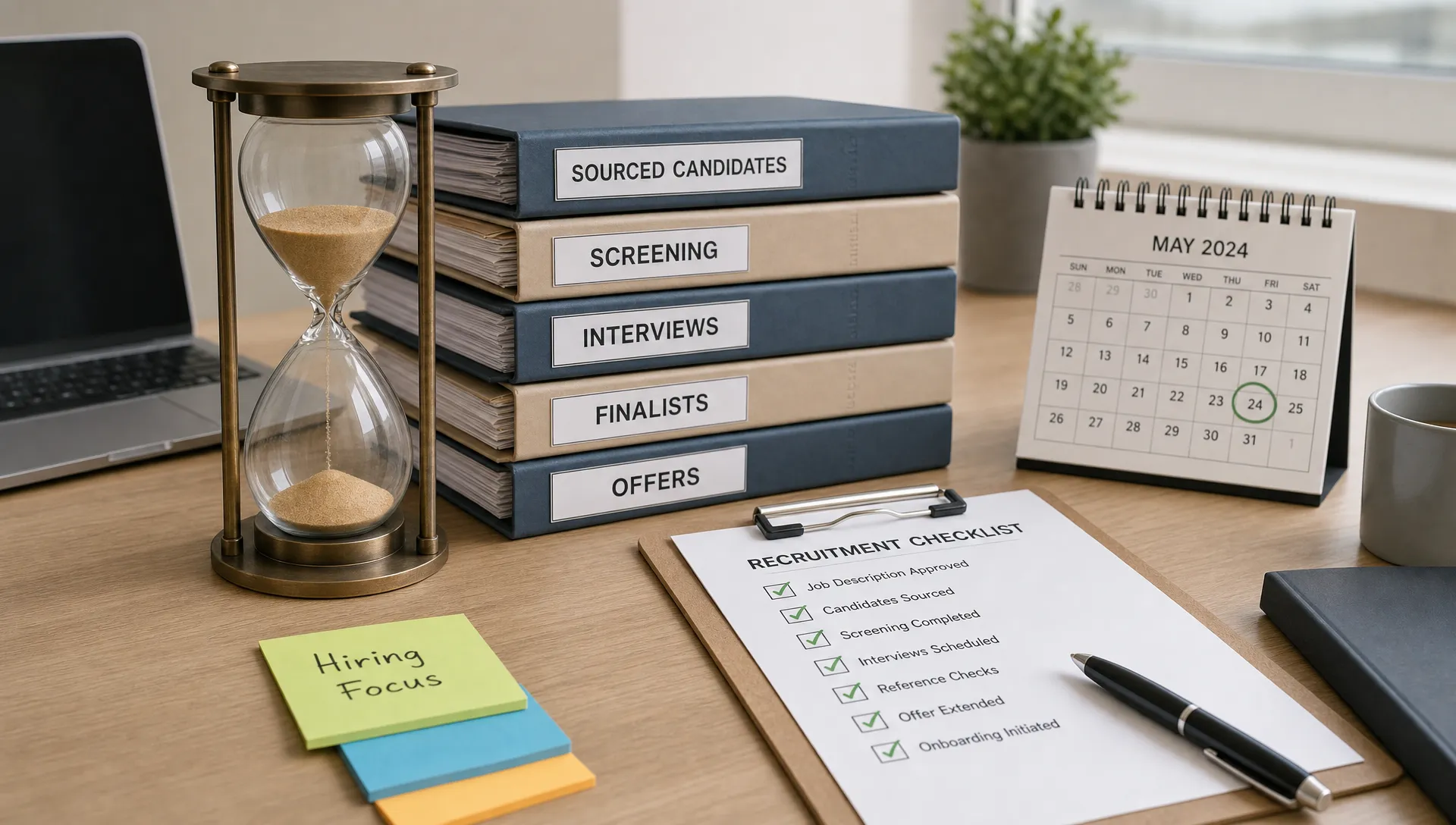
Hiring faster rarely means pushing recruiters to work harder. In most hiring processes, speed is lost in the quiet gaps between steps: waiting for a complete intake, reviewing hundreds of profiles, writing follow-up messages, coordinating calendars, updating the ATS, and chasing feedback.
That is where AI in recruitment can make a measurable difference. Used well, it does not replace the recruiter’s judgment. It removes repetitive work, keeps the pipeline moving, and gives hiring teams more time for the parts of recruiting that require human expertise: assessing fit, building trust, advising hiring managers, and closing candidates.
For agencies and HR teams, the biggest opportunity is not “more automation” for its own sake. It is building a recruiting workflow where every candidate moves to the right next step faster, with consistent criteria and a better experience.
Why hiring teams lose speed in the first place
Before looking at AI tools, it helps to understand where hiring velocity usually breaks down. Most teams do not have a single speed problem. They have a chain of small delays that compound.
A role might open before the requirements are clear. Recruiters may need to translate a vague job description into searchable criteria. Candidate profiles come in from multiple sources, but screening is inconsistent because every recruiter reviews information slightly differently. Outreach slows down when messages need personalization. Interview scheduling becomes a back-and-forth loop. Pipeline updates lag behind reality, which makes forecasting harder.
The result is familiar: strong candidates wait too long, hiring managers do not have visibility, and recruiters spend their day on coordination instead of candidate engagement.
AI in recruitment helps by turning many of these manual handoffs into structured, assisted workflows. The key word is assisted. The best systems accelerate work while keeping recruiters in control of decisions and communications.
What AI in recruitment actually speeds up
AI can support nearly every stage of the hiring workflow, but the highest-impact use cases are the ones tied to repeatable recruiter tasks. These are the places where time savings show up quickly without lowering the quality bar.
1. Intake becomes clearer from the start
A poor intake creates problems throughout the entire search. If the hiring manager’s expectations are vague, recruiters waste time sourcing the wrong candidates, screening against unclear requirements, and rewriting messaging.
AI can help turn a job description or client brief into structured role criteria. For example, it can identify must-have skills, nice-to-have qualifications, location constraints, compensation considerations, interview stages, and potential screening questions. Recruiters can then review and refine the intake before the search begins.
For recruitment agencies, this is especially valuable because every client may describe requirements differently. AI-assisted intake helps standardize what the team needs before sourcing starts.
2. Screening becomes faster and more consistent
Manual screening is one of the most obvious bottlenecks. Reviewing resumes, LinkedIn profiles, applications, and notes can take hours, especially for high-volume roles.
AI can summarize candidate information, compare profiles against agreed criteria, and produce candidate scoring with evidence. The evidence matters. A simple score is not enough, because recruiters and hiring managers need to understand why a candidate appears to match or miss the role requirements.
A responsible AI screening workflow should make it easy to answer questions like:
- Which must-have requirements are clearly met?
- Which requirements are missing or uncertain?
- What evidence supports the recommendation?
- What follow-up questions should a recruiter ask?
- Should the candidate be reviewed by a human before moving forward?
This approach helps recruiters shortlist faster while reducing the inconsistency that can happen when screening is rushed.
3. Outreach gets drafted faster, but still feels human
Candidate outreach is a high-leverage activity, yet it is also time-consuming. Recruiters need to write messages that are accurate, relevant, and tailored to the candidate’s background. Generic outreach is faster to send, but often performs worse because candidates can tell when a message was copied and pasted.
AI can draft outreach based on the role, candidate profile, company context, and preferred tone. Recruiters can then review, edit, and approve the message before it is sent. This keeps the human relationship intact while reducing the blank-page work that slows teams down.
For teams hiring across regions, multi-language outreach support can also reduce delays when candidates prefer communication in another language.
4. Candidate conversations can happen around the clock
Recruiters cannot be available at every hour, but candidates often respond outside business hours. AI chat and voice calls can help collect basic information, answer routine questions, and move candidates to the next step when a recruiter is offline.
This is especially useful for high-volume hiring, global searches, and agency environments where candidate responsiveness can make or break a placement. If a candidate expresses interest in the evening, an AI assistant can help capture availability, confirm basic qualifications, or prepare the recruiter for a follow-up the next morning.
The benefit is not just speed. It is continuity. Candidates are less likely to feel ignored, and recruiters start the next day with more complete information.
5. Scheduling stops consuming recruiter time
Interview scheduling is one of the most common sources of avoidable delay. Every email asking “Does Tuesday work?” adds friction. When multiple interviewers are involved, the delay multiplies.
AI-supported scheduling can coordinate calendars, suggest available times, send reminders, and update the pipeline when an interview is booked. This helps teams reduce time-to-interview, which is often one of the biggest drivers of overall time-to-hire.
6. Pipeline updates become more reliable
Recruiting teams often rely on their ATS or CRM as the source of truth, but busy recruiters do not always have time to update every status, note, or next step immediately. When systems fall behind, managers lose visibility and candidates can slip through the cracks.
AI can help keep pipeline data current by syncing calendars, messages, calls, and status changes into existing tools. This is important because hiring speed depends on operational clarity. Teams need to know who is waiting, who needs follow-up, and which roles are at risk.
| Recruiting bottleneck | How AI helps | Human role |
|---|---|---|
| Unclear intake | Structures briefs into role criteria and screening questions | Approve priorities and clarify tradeoffs |
| High-volume screening | Summarizes profiles and scores candidates with evidence | Review recommendations and make decisions |
| Slow outreach | Drafts personalized messages and follow-ups | Edit, approve, and manage relationships |
| Missed candidate responses | Supports chat or voice interactions outside office hours | Handle complex conversations and close candidates |
| Scheduling delays | Coordinates calendars and interview reminders | Resolve exceptions and advise stakeholders |
| Outdated pipeline data | Syncs activity and status updates across systems | Validate stages and manage hiring strategy |
Faster hiring does not mean weaker hiring
The biggest concern about AI in recruitment is understandable: if automation moves too quickly, will it miss great candidates or introduce bias?
That risk exists when AI is used without clear rules, human review, or transparency. But the solution is not to avoid AI entirely. The solution is to design recruiting workflows where AI supports structured decision-making rather than replacing it.
A strong AI-enabled hiring process should include four guardrails.
First, criteria should be defined before screening begins. AI should evaluate candidates against role-relevant requirements, not vague assumptions.
Second, recommendations should include evidence. Recruiters should be able to see why a candidate was scored a certain way and where the information came from.
Third, humans should approve important actions. Candidate rejection, outreach, and progression decisions should remain accountable to the recruiting team.
Fourth, teams should monitor fairness and compliance. In the United States, the EEOC has published guidance on software, algorithms, and employment selection procedures, including the importance of assessing adverse impact. For teams operating in Europe or handling EU candidate data, privacy and data protection obligations also need to be considered carefully.
AI can help teams hire faster, but speed is only useful if the process remains fair, explainable, and candidate-centered.
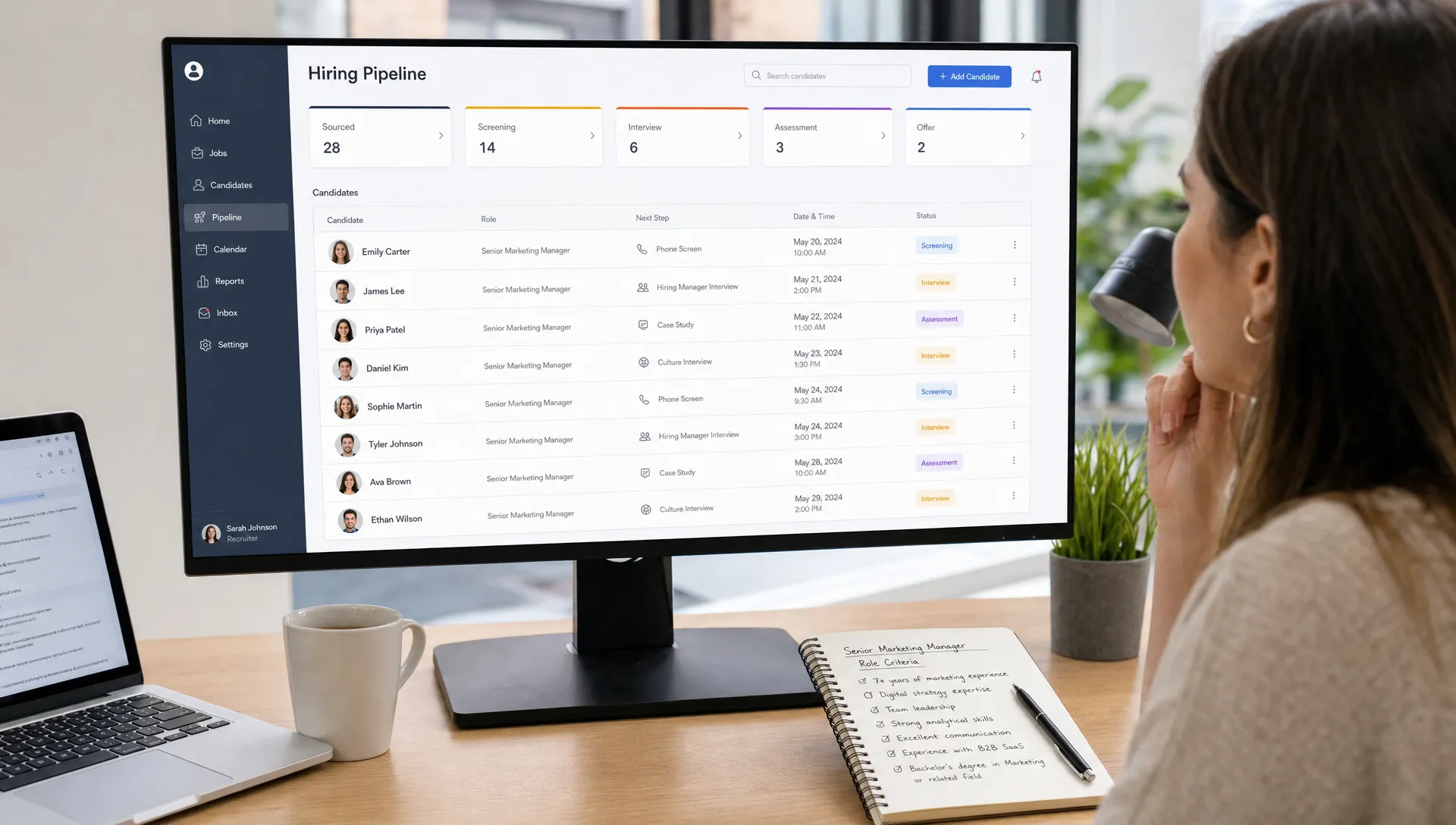
A practical AI-assisted hiring workflow
The most effective AI recruiting workflows are not complicated. They follow the same basic hiring stages recruiters already know, but reduce the manual load at each step.
A streamlined workflow might look like this:
- The recruiter receives a job description or client brief and uses AI to structure the intake.
- The hiring manager or client reviews the must-have criteria before sourcing begins.
- Candidate profiles are screened and summarized against the approved criteria.
- Outreach messages are drafted by AI and approved by a recruiter before sending.
- Interested candidates interact through chat, voice, or recruiter follow-up.
- Interviews are scheduled automatically based on availability.
- Pipeline stages, notes, and calendar activity sync back to the ATS or CRM.
- Recruiters review exceptions, coach hiring managers, and manage candidate relationships.
This workflow does not remove the recruiter. It changes where the recruiter spends time. Instead of manually copying notes, chasing availability, or writing every message from scratch, the recruiter focuses on judgment, influence, and experience.
That shift is where hiring speed becomes sustainable. A team can move faster without asking recruiters to sacrifice quality or work longer hours.
Metrics that show whether AI is helping you hire faster
To understand whether AI in recruitment is working, teams need to measure more than overall time-to-hire. Time-to-hire is useful, but it is often too broad. If it improves, you may not know which part of the process changed. If it does not improve, you may not know where the bottleneck remains.
A better approach is to measure speed at each stage of the funnel.
| Metric | What it reveals | Why it matters |
|---|---|---|
| Time from role opening to approved intake | How quickly the search becomes actionable | Poor intake delays every later step |
| Time to first shortlist | How fast recruiters identify qualified candidates | Shortlisting speed affects manager confidence |
| Candidate response time | How quickly interested candidates are engaged | Slow replies reduce momentum |
| Outreach-to-interview conversion | Whether messaging reaches the right candidates | Speed should not come at the cost of relevance |
| Time from interest to scheduled interview | How much scheduling friction exists | Calendar delays often extend time-to-hire |
| Pipeline update lag | Whether systems reflect reality | Accurate data improves forecasting and follow-up |
| Recruiter time spent on admin | How much capacity automation returns | Recovered time can be used for candidate engagement |
It is also worth tracking qualitative signals. Are candidates getting faster answers? Are hiring managers receiving clearer shortlists? Are recruiters spending more time advising and less time coordinating? These indicators often show the real value of AI before the final hiring metrics change.
How agencies can use AI to move faster
Recruitment agencies face a unique speed challenge. They often work across multiple clients, roles, industries, and communication styles. A delay in intake, outreach, or scheduling can mean losing candidates to a competitor.
AI helps agencies standardize the parts of the process that should be consistent while preserving the relationship-driven work that wins clients and candidates.
For example, AI-assisted intake can help recruiters translate client briefs into searchable criteria. Candidate scoring with evidence can help account managers present shortlists more confidently. Human-approved outreach drafting can help recruiters personalize at scale. Scheduling automation can reduce the back-and-forth between candidates, clients, and internal teams.
The result is a more responsive agency workflow. Recruiters can support more searches without letting candidate experience or client communication degrade.
How in-house HR teams can use AI to hire faster
In-house HR and talent acquisition teams often struggle with volume, stakeholder alignment, and internal coordination. Hiring managers may have limited availability. Interview panels can be difficult to schedule. Recruiters may be responsible for multiple open roles at once.
AI can help by bringing structure and consistency to the process. Intake support creates alignment before sourcing begins. Screening summaries help recruiters and hiring managers review candidates with the same criteria. Automated scheduling reduces friction across internal calendars. Pipeline sync gives talent leaders better visibility into where roles are slowing down.
For HR teams, the biggest advantage is consistency. When every role follows a clearer process, hiring becomes easier to manage and easier to improve.
Common mistakes to avoid when using AI in recruitment
AI can accelerate hiring, but only if teams implement it thoughtfully. The wrong setup can create more confusion, not less.
One common mistake is automating before defining the process. If the intake is unclear, AI may simply help teams move faster in the wrong direction.
Another mistake is treating AI scores as final decisions. Scores should support recruiter judgment, not replace it. A candidate with an unusual background may still be highly relevant, and a human recruiter is often best placed to recognize that context.
Teams should also avoid disconnected tools. If AI outputs do not sync with the ATS, CRM, calendar, or communication channels, recruiters may end up copying information between systems, which reduces the time savings.
Finally, do not ignore candidate experience. Candidates should receive clear, respectful communication. If AI is involved in chat, calls, or outreach drafting, the tone and accuracy of those interactions still reflect your employer brand.
Where CandiDesk fits into faster hiring
CandiDesk is an AI-first recruitment platform built for agencies and HR teams that want to hire faster while keeping recruiters in control. It supports the repetitive parts of recruiting, including intake, candidate screening, outreach drafting, scheduling, and pipeline updates.
The platform is designed to work with existing ATS, CRM, and communication tools, so teams can improve speed without rebuilding their entire workflow. CandiDesk also supports AI chat and voice calls, multi-language outreach, calendar sync, and GDPR-focused data handling. Importantly, outreach is human-approved before it sends, which helps teams maintain quality and accountability.
That combination matters. The goal is not to remove recruiters from the process. The goal is to give them a 24/7 assistant workflow that handles repetitive coordination while recruiters focus on the decisions and relationships that shape great hires.
Frequently Asked Questions
How does AI in recruitment reduce time-to-hire? AI reduces time-to-hire by speeding up intake, screening, outreach drafting, interview scheduling, and pipeline updates. It removes repetitive manual work and helps candidates move through the funnel with fewer delays.
Can AI screen candidates without replacing recruiters? Yes. In a responsible workflow, AI summarizes profiles and scores candidates with evidence, while recruiters review the results and make decisions. AI should support human judgment, not replace it.
Is AI useful for both agencies and internal HR teams? Yes. Agencies can use AI to manage multiple client searches more consistently, while internal HR teams can use it to improve stakeholder alignment, scheduling, and pipeline visibility.
What should recruiters keep human when using AI? Recruiters should keep final decisions, sensitive candidate conversations, hiring manager advisory work, and relationship-building human-led. AI is best used for repetitive, structured, and time-consuming tasks.
How can teams use AI responsibly in recruitment? Teams should define role criteria upfront, require evidence for recommendations, keep humans in approval loops, monitor outcomes, and ensure data handling aligns with applicable privacy and employment rules.
Make hiring faster without losing control
AI in recruitment works best when it gives recruiters more time for high-value work. Faster intake, evidence-based screening, human-approved outreach, automated scheduling, and cleaner pipeline updates all help teams move quickly without sacrificing quality.
If your team is spending too much time on repetitive coordination, CandiDesk can help you build a faster, more consistent recruiting workflow while keeping humans in control of the moments that matter most.

Nikon Mazur
Nikon is a recruiting technology specialist with over five years of hands on experience building HR and hiring software, and the co founder of CandiDesk.
LinkedIn Profile