
recruitment platform
Choosing the Right Recruitment Platform in 2026
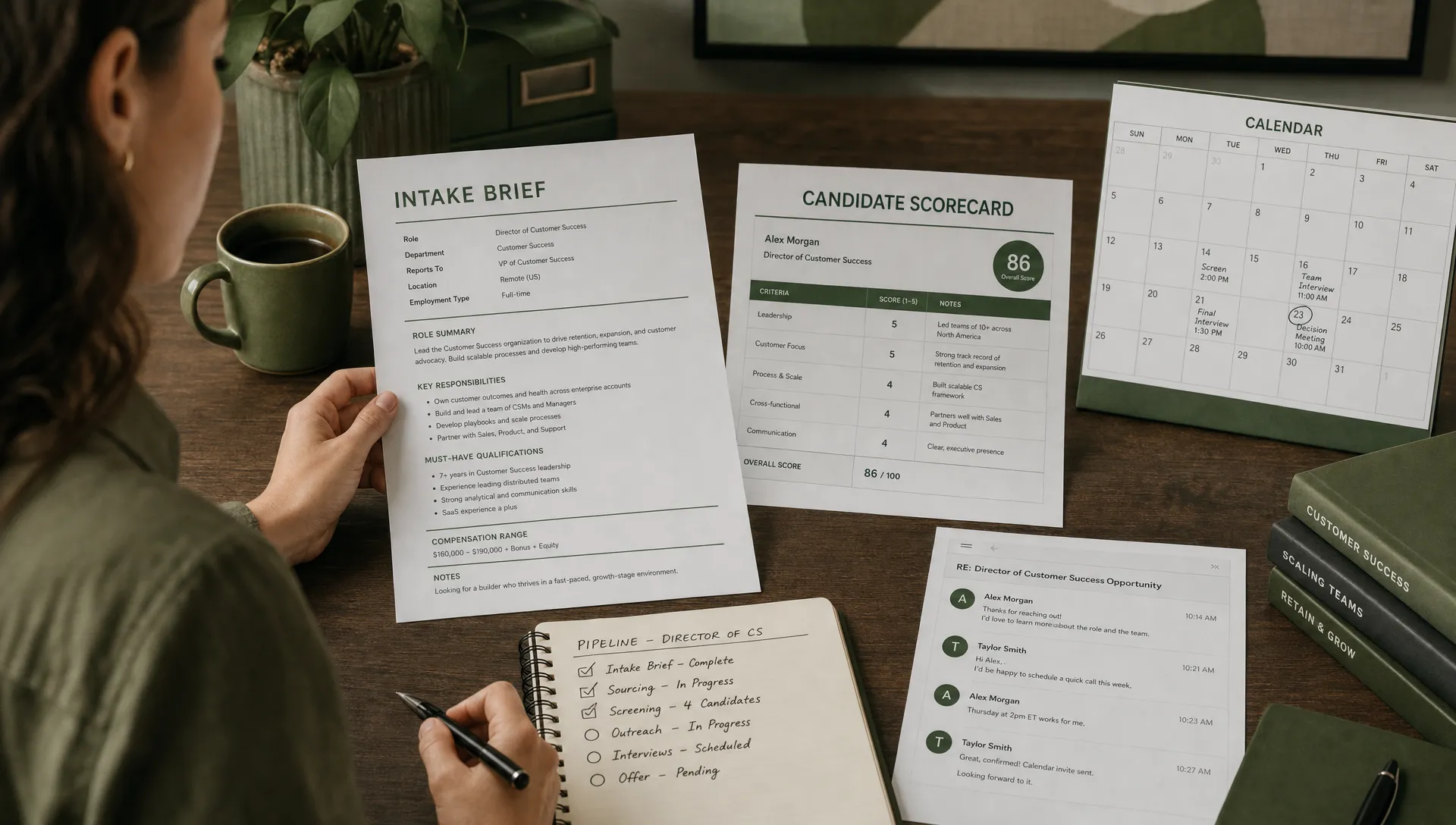
Recruiting in 2026 is not suffering from a lack of software. It is suffering from a lack of fit.
Most agencies and HR teams already have an ATS, a calendar tool, email, LinkedIn workflows, spreadsheets, job boards, assessment tools, and reporting dashboards. Yet recruiters still lose time clarifying hiring manager requirements, screening inconsistent resumes, chasing interview availability, rewriting outreach, and updating pipelines after every call.
That is why choosing the right recruitment platform now requires a more practical lens. The question is not, “Which tool has the longest feature list?” It is, “Which platform removes the most friction from the way our team actually hires, without reducing quality, compliance, or recruiter control?”
Below is a clear framework for evaluating recruitment platforms in 2026, including what to prioritize, what to avoid, and how to compare options before signing a contract.
What a modern recruitment platform should actually do
A recruitment platform is no longer just a place to store candidates. In 2026, the strongest platforms help coordinate the full hiring workflow, from the first intake conversation to interview scheduling and pipeline follow-up.
At minimum, a modern platform should help your team manage:
- Job and client intake
- Candidate sourcing or candidate import
- Screening and qualification
- Outreach drafting and follow-up
- Interview scheduling
- Candidate and hiring manager communication
- Pipeline updates
- Reporting and workflow visibility
- Integrations with ATS, CRM, calendar, email, and communication tools
The best platforms do not force recruiters to abandon their judgment. Instead, they handle repetitive work, surface useful evidence, and make it easier for humans to make consistent decisions.
This distinction matters because AI is now present in almost every recruiting product. Some tools use AI as a small add-on, while others are built around AI-assisted workflows. If you are specifically comparing AI-enabled options, CandiDesk’s guide on what to look for in AI recruitment software is a useful companion to this broader evaluation framework.
Start with your hiring workflow, not the vendor demo
Vendor demos are designed to look smooth. Your hiring process probably is not.
Before comparing platforms, map the real workflow your recruiters follow today. Include the messy parts: unclear job briefs, missing salary ranges, duplicated candidate records, hiring managers who reply late, interview no-shows, candidates who need follow-up outside business hours, and manual updates that happen after calls.
A simple audit should answer four questions:
- Where do recruiters lose the most time? Look for repeated admin, duplicate data entry, scheduling delays, status updates, and follow-up tasks.
- Where does quality break down? Look for vague intake, inconsistent screening, subjective shortlists, and weak evidence behind candidate recommendations.
- Where do candidates experience friction? Look for slow replies, unclear next steps, repeated questions, and scheduling back-and-forth.
- Where do managers or clients lose confidence? Look for poor visibility, inconsistent updates, or candidates being sent without clear justification.
Once you know those answers, the platform evaluation becomes much easier. A recruitment platform should solve your most expensive workflow problems first. Everything else is secondary.
The 2026 recruitment platform evaluation checklist
Use the criteria below to compare platforms in a structured way. This keeps the conversation focused on outcomes instead of flashy features.
| Evaluation area | What to look for | Why it matters |
|---|---|---|
| Intake quality | Structured briefs, role requirements, must-haves, deal-breakers, and context capture | Better intake improves screening, outreach, and shortlist quality |
| Screening depth | Candidate scoring with clear evidence, not just keyword matching | Recruiters need explainable recommendations they can trust |
| Recruiter control | Human approval before candidate-facing messages or decisions | Automation should support judgment, not replace accountability |
| Communication | AI-assisted email, chat, voice, and follow-up workflows | Faster response times improve candidate experience |
| Scheduling | Calendar sync, availability matching, reminders, and rescheduling support | Interview coordination is one of the easiest bottlenecks to remove |
| Integrations | ATS, CRM, calendar, email, and messaging compatibility | A platform should fit your stack, not create another silo |
| Compliance | GDPR-focused handling, audit trails, consent workflows, and bias risk controls | Hiring technology must be defensible and transparent |
| Reporting | Pipeline visibility, conversion metrics, activity tracking, and bottleneck analysis | Teams need to know where hiring slows down |
| Scalability | Multi-role, multi-client, multi-language, or high-volume workflows | The platform should grow with your hiring complexity |
This table is intentionally practical. A platform can be impressive and still be wrong for your team if it does not improve your highest-friction workflows.
Prioritize structured intake and evidence-based screening
Many hiring problems begin before sourcing even starts. If the job brief is vague, every downstream step becomes harder. Recruiters screen against assumptions, candidates receive generic outreach, and hiring managers reject profiles for reasons that were never captured upfront.
A strong recruitment platform should help convert a client brief or hiring manager conversation into a structured intake. That means documenting skills, experience, responsibilities, compensation range, location constraints, seniority, deal-breakers, and context about why the role is open.
From there, screening should be evidence-based. In 2026, “AI match score” is not enough. Recruiters need to understand why a candidate is being recommended. The platform should show the evidence behind a score, such as relevant experience, matching skills, role-specific signals, gaps, and uncertainties.
This is especially important for agencies. When presenting candidates to clients, a recruiter needs more than a resume and a gut feeling. They need a clear, defensible explanation for why each candidate is worth considering.
If your team struggles with intake quality and pipeline consistency, you may also find CandiDesk’s article on how a recruitment management platform adds control useful when defining your internal requirements.
Choose automation that keeps recruiters in control
Automation is valuable when it removes low-value work. It becomes risky when it hides important decisions.
In recruiting, the safest and most useful model is human-controlled automation. The platform can draft outreach, summarize calls, suggest next steps, score candidates, and prepare scheduling options. But recruiters should remain able to review, edit, approve, or reject important actions before they affect a candidate or client relationship.
This matters for three reasons.
First, recruiting is relationship-based. A poorly worded automated message can damage trust with a candidate, client, or hiring manager.
Second, hiring decisions carry legal and ethical weight. Recruiters need visibility into how recommendations are made and what information is being used.
Third, every role has nuance. A platform should help recruiters move faster, but it should not flatten every hiring process into the same rigid workflow.
For AI-related governance, the NIST AI Risk Management Framework is a helpful reference for thinking about trustworthiness, transparency, and risk management in AI systems. Recruiting teams do not need to become AI auditors, but they do need to ask better questions about how AI is used.
Look closely at integrations and data movement
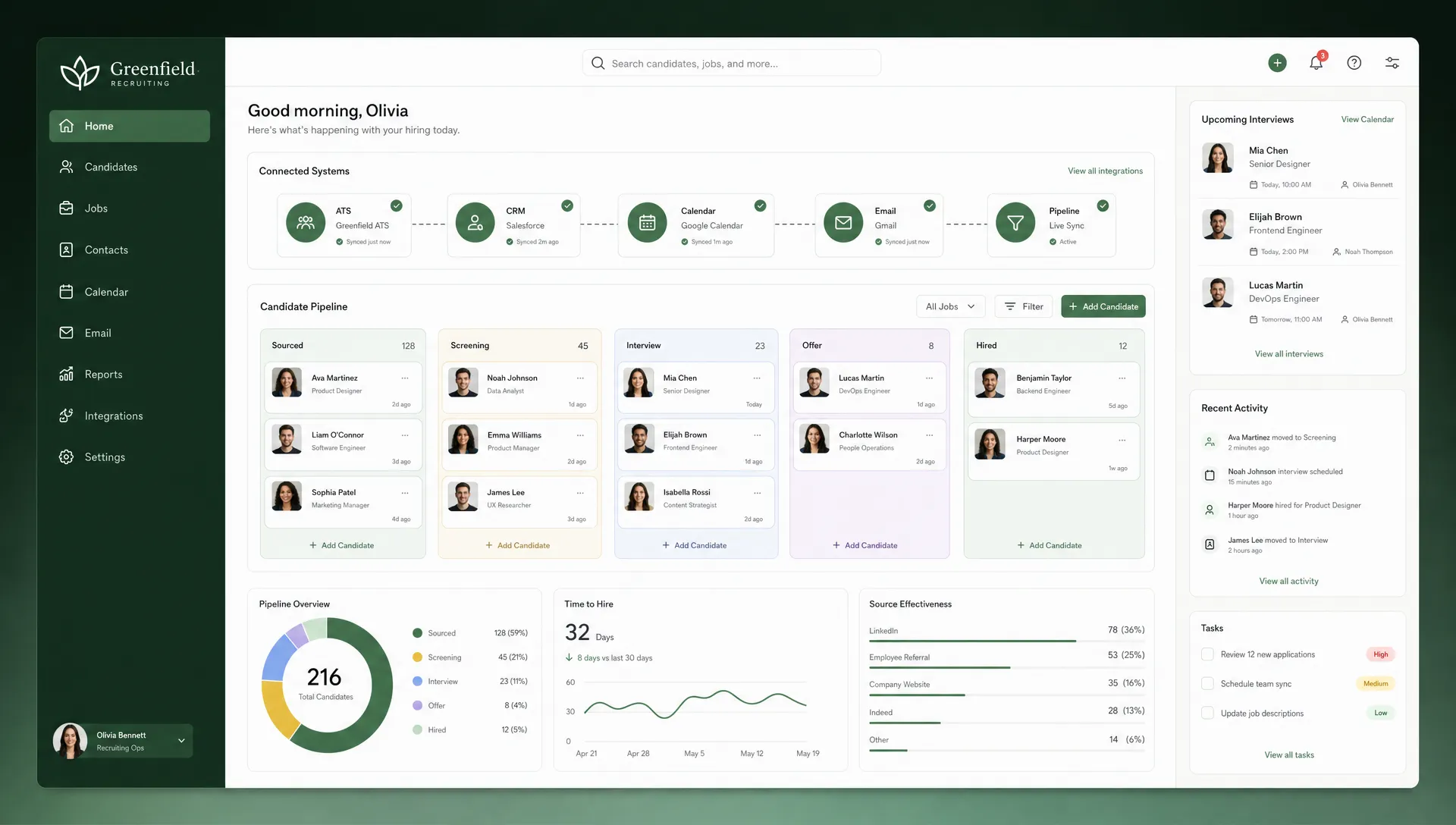
A recruitment platform should not become yet another tab recruiters forget to update. It needs to connect with the tools your team already uses.
For most teams, that means integrations with an ATS, CRM, calendar, email, communication tools, and sometimes sourcing databases or job boards. For staffing agencies, CRM connectivity is especially important because client relationships, job orders, candidate histories, and business development activity often live across multiple systems.
Data migration also deserves more attention than it usually gets. If you are moving records from an old system, cleaning duplicate contacts, or importing client data, the quality of that migration will shape adoption from day one. For teams thinking through CRM data structure before a platform rollout, resources on CRM data import and customer data migration can be useful context, especially when planning how clean, consistent records should flow into connected business systems.
Before buying, ask vendors how data moves in and out of the platform. Can you sync pipeline stages? Can recruiter notes, call outcomes, and interview dates flow back to the ATS or CRM? Can you export your data if you leave? Can permissions be configured by role, team, or client?
Evaluate candidate experience, not just recruiter efficiency
Recruiter productivity is important, but candidate experience is where many platforms quietly fail.
A platform that speeds up screening but sends robotic outreach will hurt response rates. A platform that automates scheduling but gives candidates confusing instructions will create frustration. A platform that captures call notes but fails to trigger timely follow-up will still leave candidates waiting.
In 2026, candidates expect communication that is fast, clear, and personalized. They also expect employers and agencies to handle their data responsibly. A good recruitment platform should help teams respond quickly while still sounding human.
Look for capabilities such as:
- Personalized outreach drafts that recruiters can approve
- Multi-language communication support where relevant
- Interview reminders and easy rescheduling
- Candidate status visibility or timely updates
- Consistent follow-up after calls and interviews
This is where AI-assisted communication can be powerful. It can help draft messages, summarize context, and maintain momentum outside normal working hours. But again, the best platforms keep recruiters in control of what gets sent.
Do not ignore compliance and bias risk
Recruiting technology is under increasing scrutiny. In the United States, employers need to be aware of discrimination risk when using selection tools. The EEOC has published guidance on assessing adverse impact in software, algorithms, and AI used in employment selection procedures, which is worth reviewing if your platform influences candidate ranking or screening.
For teams hiring in or from Europe, GDPR obligations and the EU AI Act add another layer of responsibility. Even if your organization is not directly subject to every regulation, the direction is clear: hiring tools must become more transparent, auditable, and privacy-conscious.
When evaluating a recruitment platform, ask:
- What candidate data is collected, stored, and processed?
- Where is the data hosted?
- How are candidate consent and deletion requests handled?
- Can recruiters see why a candidate received a score or recommendation?
- Are automated recommendations explainable?
- Can the team audit communication and decision history?
- Does the platform support role-based access and data minimization?
Compliance should not be treated as a final legal review after procurement. It should be part of the platform shortlist from the beginning.
Match the platform to your team type
The right recruitment platform depends heavily on who is using it.
An internal HR team hiring for one company needs consistency, employer brand alignment, stakeholder visibility, and compliance controls. A staffing agency needs speed across multiple clients, strong CRM integration, fast intake, repeatable workflows, and the ability to manage many roles at once. An executive search team may prioritize discreet outreach, relationship history, long-cycle pipeline management, and high-touch communication.
Here is a simplified way to think about fit:
| Team type | Primary need | Platform capabilities to prioritize |
|---|---|---|
| In-house HR | Consistent hiring across departments | Structured intake, manager collaboration, compliance, reporting |
| Staffing agency | Speed and control across many roles and clients | CRM and ATS integrations, screening, outreach, scheduling, pipeline updates |
| Executive search | Relationship-led candidate engagement | High-quality outreach, notes, research context, pipeline history |
| High-volume hiring team | Fast coordination at scale | Automated scheduling, screening workflows, chat or voice support, reminders |
| Global recruiting team | Consistency across markets | Multi-language outreach, permissions, compliance, localized workflows |
If you operate a staffing or recruiting agency, it is also worth reviewing how recruitment software for staffing agencies differs from general HR software. The workflows, data requirements, and client-facing expectations are often very different.
Red flags when choosing a recruitment platform
Not every platform that looks modern will improve your hiring process. Watch for warning signs during evaluation.
A major red flag is a black-box scoring system. If the vendor cannot explain how candidates are evaluated or what evidence supports a recommendation, your recruiters may struggle to trust the results.
Another red flag is automation without approval controls. Fully automated outreach may sound efficient, but most teams need review workflows to protect tone, accuracy, and compliance.
Poor integration depth is also a common issue. A vendor may claim to integrate with your ATS or CRM, but the real question is what data syncs, how often, and in which direction.
Finally, be cautious with platforms that require your team to completely redesign its process before seeing value. Some workflow change is normal, but the platform should reduce friction, not create months of operational disruption.
Questions to ask before buying
Before committing to a platform, use discovery calls and pilots to test how the product behaves in realistic scenarios. Do not rely only on polished demo data.
Ask vendors:
- How does the platform convert intake notes or client briefs into role requirements?
- How are candidate scores generated, and what evidence can recruiters review?
- Can recruiters approve AI-generated outreach before it is sent?
- Which ATS, CRM, calendar, and communication tools are supported?
- What data syncs automatically, and what still requires manual updates?
- How does the platform handle interview scheduling and rescheduling?
- Can it support multiple languages or regions if needed?
- What controls exist for GDPR, permissions, audit logs, and data deletion?
- How long does implementation typically take for a team like ours?
- What support is available during rollout and adoption?
The strongest vendors should welcome these questions. If the answers are vague, that is useful information.
How CandiDesk fits this 2026 evaluation framework
CandiDesk is an AI-first recruitment platform built for agencies and HR teams that want to hire faster while keeping recruiters in control. It supports core workflows such as smart intake from client briefs, candidate scoring with evidence, AI chat and voice calls, human-approved outreach drafting, interview scheduling automation, pipeline and calendar sync, multi-language outreach support, ATS and CRM integrations, 24/7 assistant workflows, and GDPR-focused data handling.
The important point is not that every team needs every feature. The point is that recruiting teams increasingly need connected workflows. Intake, screening, communication, scheduling, and pipeline updates should not operate as separate islands.
For teams evaluating platforms in 2026, CandiDesk is most relevant if your current process is slowed down by manual coordination, inconsistent screening, delayed follow-up, or disconnected systems. It is especially worth considering if your recruiters want AI support without losing approval over candidate-facing communication.
A practical selection process
Once you have a shortlist, run a structured evaluation instead of relying on opinions.
Start with two or three real roles. Include one straightforward role, one hard-to-fill role, and one role with messy intake or stakeholder complexity. Ask each vendor to show how their platform handles those scenarios.
Then compare the results across five dimensions: time saved, quality of recommendations, recruiter trust, candidate experience, and operational fit.
If possible, involve recruiters, recruiting operations, hiring managers, compliance, and IT early. Each group will notice different risks. Recruiters will know whether the workflow feels usable. Operations will see reporting and process gaps. IT will assess integrations and security. Compliance will evaluate data handling and decision transparency.
A recruitment platform is not just a software purchase. It is an operating layer for how your organization hires.
Frequently Asked Questions
What is a recruitment platform? A recruitment platform is software that helps teams manage hiring workflows such as intake, candidate screening, outreach, scheduling, pipeline tracking, and reporting. Modern platforms often connect with ATS, CRM, calendar, and communication tools.
How is a recruitment platform different from an ATS? An ATS usually focuses on tracking applicants and managing hiring records. A recruitment platform may sit alongside or integrate with an ATS to automate and coordinate broader workflows, such as intake, outreach, screening, calls, scheduling, and updates.
What should I prioritize when choosing a recruitment platform in 2026? Prioritize workflow fit, evidence-based screening, recruiter control, integration depth, candidate experience, compliance, and reporting. Avoid choosing based only on feature quantity or AI claims.
Is AI safe to use in recruiting? AI can be useful in recruiting when it is transparent, monitored, and used with human oversight. Teams should understand how AI recommendations are generated, review candidate-facing communication, and assess compliance and bias risks.
How long does it take to implement a recruitment platform? Implementation time varies based on integrations, data migration, team size, and workflow complexity. A simple rollout may be faster, while multi-system agency or enterprise environments usually require more planning and testing.
Choose a platform that improves how your team really hires
The right recruitment platform in 2026 should make hiring faster, clearer, and more consistent without removing human judgment from the process.
If your team is ready to reduce manual work across intake, screening, outreach, scheduling, and pipeline updates, CandiDesk can help you evaluate what an AI-first recruiting workflow could look like while keeping recruiters in control of the moments that matter most.

Nikon Mazur
Nikon is a recruiting technology specialist with over five years of hands on experience building HR and hiring software, and the co founder of CandiDesk.
LinkedIn Profile