
ai hiring
AI Hiring Best Practices for Agencies and HR Teams

AI can now take over a large share of the recruiting admin that used to drain agency and HR teams: intake notes, candidate screening, outreach drafts, interview scheduling, call follow-ups, and pipeline updates. But better automation does not automatically mean better hiring.
The real advantage comes from using AI hiring as an operating system for consistency, speed, and recruiter focus, while keeping humans responsible for judgment, relationships, and final decisions. If the underlying workflow is vague, biased, or poorly governed, AI will only make the problems move faster.
The best practices below are designed for agencies and in-house HR teams that want to use AI in a practical, defensible way. The goal is not to replace recruiters. It is to help them spend less time on repetitive coordination and more time on the work that actually changes hiring outcomes.
Why AI hiring needs a clear operating model
AI in recruitment touches sensitive moments: who gets contacted, who gets advanced, how candidates are evaluated, and how hiring managers interpret evidence. That makes it different from generic productivity automation.
A strong AI hiring process answers four questions before a tool is rolled out:
- What tasks can AI perform independently?
- What outputs require recruiter approval before they reach a candidate or client?
- What data can the AI access, store, or summarize?
- How will the team check whether AI is improving quality, not just speed?
For most agencies and HR teams, the right model is assistant-led, human-controlled. AI can draft, summarize, score, remind, schedule, and update systems. Recruiters and hiring managers still own the brief, the shortlist, candidate communication standards, compliance oversight, and hiring decisions.
If your team is still mapping where automation can remove delays, CandiDesk’s guide to how AI in recruitment helps teams hire faster is a useful companion to this best-practice playbook.
1. Start with structured intake, not a better prompt
The quality of AI hiring starts before the first candidate is screened. If the intake brief is weak, AI will optimize for incomplete or misleading criteria.
Agencies often receive client briefs that mix must-haves, nice-to-haves, urgency, personality preferences, and legacy assumptions. HR teams face a similar issue when hiring managers describe the same role differently across departments. AI can help standardize intake, but only if the team defines what a good brief should include.
A strong intake captures role outcomes, not just keywords. It should clarify the business problem behind the hire, the skills required on day one, the skills that can be learned, compensation boundaries, location constraints, interview steps, and disqualifying requirements.
Domain context also matters. An agency hiring sanitation, maintenance, or plant operations leaders for a food production client should capture operational details that generic job descriptions often miss, such as poultry processing requirements, conveyor hygiene, or sustainable cleaning and contamination-control solutions. Those details can change what qualified experience looks like.
| Intake element | Why it matters for AI hiring | Example of a stronger input |
|---|---|---|
| Role outcomes | Helps AI screen for impact, not keyword density | Reduce production downtime across three shifts |
| Must-have evidence | Keeps scoring grounded in observable experience | Managed multi-site payroll implementation |
| Trainable skills | Prevents over-filtering promising candidates | Can learn the company’s internal CRM |
| Constraints | Reduces wasted outreach and scheduling | Hybrid in Chicago, salary range approved |
| Interview plan | Helps automate next steps consistently | Recruiter screen, hiring manager call, panel interview |
Best practice: create a reusable intake template for every role family. Let AI help extract and organize the brief, but require a recruiter or hiring manager to approve the final criteria before sourcing or screening begins.
2. Define what AI may do, and what it may not do
AI hiring works best when responsibilities are explicit. Without boundaries, teams can slide from AI-assisted work into AI-made decisions without noticing.
A clear responsibility matrix keeps everyone aligned. It also helps when explaining your process to clients, candidates, legal teams, and senior leadership.
| Recruiting task | Good use of AI | Human responsibility |
|---|---|---|
| Intake | Summarize briefs and identify missing information | Approve final role criteria |
| Screening | Extract evidence and suggest match strength | Decide who advances |
| Outreach | Draft personalized messages | Approve tone, accuracy, and timing |
| Scheduling | Coordinate calendars and reminders | Handle exceptions and candidate concerns |
| Pipeline updates | Sync statuses and notes | Validate sensitive decisions |
This distinction is especially important for agencies. Clients may welcome faster shortlists, but they still expect the recruiter to defend why each candidate was presented. In-house HR teams face similar expectations from hiring managers, compliance teams, and candidates who want fair consideration.
Best practice: document AI’s role in your recruitment process. Keep it simple enough for every recruiter to understand and practical enough to apply during busy hiring cycles.
3. Make candidate scoring evidence-based
A candidate score is only useful if a recruiter can understand it. A black-box percentage that says a candidate is an 82 percent match does not help much unless it explains why.
Evidence-based scoring is one of the most important AI hiring best practices because it protects both quality and trust. The AI should point to concrete signals: relevant roles, specific achievements, required certifications, industry experience, location fit, compensation alignment, availability, and interview notes. It should also flag missing evidence instead of pretending to know.
For example, a useful AI-generated screening summary might say that a candidate has led enterprise CRM migrations, managed stakeholder training, and worked in a similar industry, but that salary expectations and willingness to travel still need confirmation. That gives the recruiter a clear next step.
A weak AI summary might simply say that the candidate is a strong match because their resume contains several keywords. That creates false confidence and can lead to poor shortlists.
When comparing tools, prioritize the criteria covered in CandiDesk’s guide on what to look for in AI recruitment software, especially structured intake, evidence-based scoring, human approval workflows, scheduling automation, and integrations.
Best practice: require every AI recommendation to include supporting evidence. If the tool cannot explain the match in recruiter-friendly language, do not use the score as a decision input.
4. Keep outreach human-approved and candidate-centered
AI can write fast. Recruiters need to make sure it writes well.
Candidate outreach is one of the most visible parts of the hiring process. A poorly personalized message can damage a client brand, reduce response rates, and make passive candidates feel like they are being spammed. This is especially risky for agencies working across multiple clients, job families, and languages.
AI should help draft outreach based on the role, candidate background, previous touchpoints, and recruiter guidance. But for most teams, candidate-facing messages should be reviewed before sending, especially when the message concerns compensation, relocation, seniority, rejection, or interview feedback.
Good AI-assisted outreach has three qualities. It is relevant to the candidate’s background, honest about the opportunity, and easy to respond to. It should not overpromise, invent details, or use fake familiarity.
CandiDesk is built around this kind of recruiter control, with human-approved outreach drafting, AI chat and voice workflows, scheduling automation, and multi-language outreach support. The principle is simple: AI can prepare the work, but recruiters approve the message before it represents the team.
Best practice: create outreach guidelines for AI drafts. Include tone, required disclosures, banned claims, compensation rules, and escalation triggers for sensitive candidate questions.
5. Automate scheduling without losing accountability
Scheduling is one of the safest and highest-return areas for AI automation. It is repetitive, time-sensitive, and often responsible for unnecessary delays.
For agencies, faster scheduling can improve submission-to-interview conversion and reduce the risk of candidates going cold. For HR teams, it can reduce back-and-forth between recruiters, hiring managers, interview panels, and candidates.
AI can suggest times, send reminders, reschedule when needed, update calendars, and sync interview statuses back into the ATS or CRM. The best workflows also keep recruiters informed when a candidate does not respond, cancels repeatedly, or raises a concern.
The key is not to disappear from the process. Candidates should still know how to reach a human. Hiring managers should still understand the next step. Recruiters should still review exceptions instead of letting the system silently move people through the funnel.
Best practice: automate the coordination, not the relationship. Use AI to remove friction, then have recruiters step in when context, judgment, or empathy is needed.
6. Build privacy, fairness, and compliance in from day one
AI hiring creates a larger responsibility to manage candidate data carefully. Teams need to know what data is collected, where it is stored, how long it is retained, who can access it, and whether candidates have been given appropriate notices.
For organizations hiring in or from Europe, GDPR considerations are central. For US employers, anti-discrimination laws and local rules around automated employment decision tools may also apply depending on the jurisdiction. Agencies may have an additional layer of responsibility because they handle data on behalf of clients.
Fairness also needs practical review. AI should not screen people out based on protected characteristics or proxies for those characteristics. It should be tested across role types, candidate sources, languages, and experience levels. Recruiters should regularly review false negatives, not only the candidates AI recommends.
Strong governance includes role-based access, retention policies, audit-ready notes, clear approval steps, and a process for candidate inquiries. If AI summaries or call notes are stored in your ATS, make sure your team understands how they may be used later.
Best practice: involve HR, legal, compliance, and recruiting operations before scaling AI workflows. It is easier to design responsible guardrails early than to repair trust after a poor rollout.
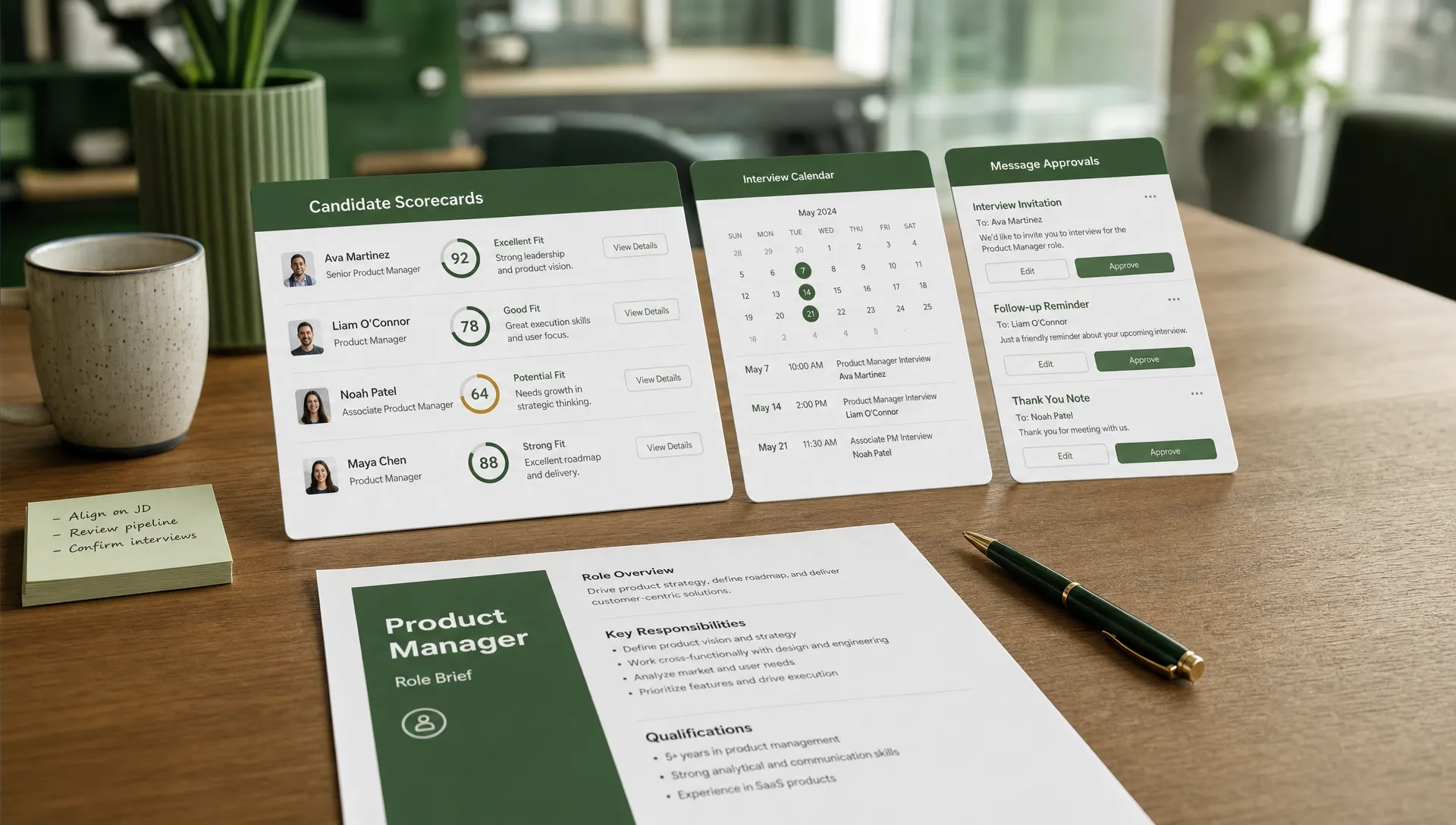
7. Tailor AI hiring workflows for agencies and HR teams
Agencies and in-house HR teams share many recruiting tasks, but they do not have the same pressures. The best AI hiring setup reflects the team’s operating model.
Agencies usually need speed, client-ready evidence, multi-role coverage, and tight CRM or ATS updates. They may also need to switch tone and criteria between clients throughout the day. HR teams often need hiring manager alignment, internal approvals, consistent candidate experience, and compliance reporting across departments.
| Team type | Main AI hiring priority | Best practice |
|---|---|---|
| Staffing agency | Move quickly from brief to qualified shortlist | Standardize intake and evidence notes per client |
| Executive search firm | Protect personalization and candidate trust | Use AI for research and drafts, not generic mass outreach |
| Corporate HR team | Keep hiring managers aligned | Use shared scorecards and consistent interview workflows |
| High-volume recruiting team | Reduce repetitive coordination | Automate screening support, scheduling, and reminders |
| Global hiring team | Manage language and time zone complexity | Use multilingual outreach and calendar automation with review steps |
The practical difference is where human review should happen. Agencies may need stricter approval before sending client-facing candidate summaries. HR teams may need stricter approval before rejection messages, internal interview notes, or workflow changes that affect compliance.
Best practice: do not copy another team’s AI workflow without adapting it. Start from your bottlenecks, risk profile, candidate volume, and stakeholder expectations.
8. Put recruiters in the loop at the highest-value moments
Human-in-the-loop does not mean a recruiter must approve every small automation. That would defeat the purpose of AI. It means humans review the moments where context, ethics, relationship quality, or business judgment matter.
The highest-value review points usually include intake approval, scorecard setup, shortlist decisions, candidate-facing messages, rejection communication, offer-stage discussions, and any situation where AI confidence is low.
Recruiters should also review edge cases. A candidate with a nontraditional background may not match a standard pattern but could still be highly relevant. A resume gap may have a legitimate explanation. A senior candidate may use different wording than the job description but still have the right experience.
Best practice: design escalation rules. AI should know when to ask for help, such as when criteria conflict, candidate data is incomplete, compensation is unclear, or a candidate asks a sensitive question.
9. Measure hiring quality, not only speed
Speed is useful, but it is not the whole story. A team can reduce time-to-screen while still sending weak candidates, annoying applicants, or creating compliance risk.
The strongest AI hiring programs measure both efficiency and quality. They look at whether recruiters are saving time, whether hiring managers accept more shortlists, whether candidates respond more often, and whether the process remains consistent.
| Metric | What it reveals | Why it matters |
|---|---|---|
| Time from intake to approved brief | Intake quality and stakeholder alignment | Prevents rushed screening based on vague criteria |
| Time to first qualified shortlist | Workflow speed | Shows whether AI reduces manual bottlenecks |
| Shortlist acceptance rate | Candidate relevance | Measures whether hiring managers trust submissions |
| Candidate response rate | Outreach quality | Reveals whether AI-assisted messaging feels relevant |
| Interview show rate | Scheduling and engagement quality | Highlights candidate commitment and reminder effectiveness |
| Source-to-hire conversion | Pipeline effectiveness | Shows which channels produce real outcomes |
| Recruiter override rate | AI recommendation quality | Helps detect over-filtering or weak scoring rules |
Recruiter override rate is especially valuable. If recruiters constantly disagree with AI recommendations, the intake, scoring logic, or data quality may need improvement. If they never disagree, the team may not be reviewing carefully enough.
Best practice: review AI hiring metrics weekly during rollout, then monthly once workflows stabilize. Combine dashboard data with recruiter feedback and hiring manager input.
A practical rollout plan for agencies and HR teams
The safest way to adopt AI hiring is to start small, prove value, then expand. A controlled pilot helps teams learn how AI behaves in real recruiting situations without risking the entire process.
A practical 30-day pilot can focus on one role family, one client segment, or one department. Choose a workflow with enough volume to learn from but not so much risk that mistakes would be costly.
Use this sequence:
- Select one or two recurring roles with clear hiring criteria.
- Create a structured intake template and approved scorecard.
- Connect the relevant ATS, CRM, calendar, and communication tools where appropriate.
- Run AI recommendations in parallel with recruiter review for the first hiring cycle.
- Compare AI summaries, recruiter decisions, hiring manager feedback, and candidate outcomes.
- Adjust criteria, approval rules, and escalation triggers before expanding.
Do not judge the pilot only by how much faster the team moves in week one. Early review may feel slower because recruiters are learning the system and validating outputs. The real question is whether the workflow becomes more consistent and scalable by the end of the pilot.
Best practice: assign an owner for the AI hiring rollout. This person should collect feedback, monitor usage, update playbooks, and make sure recruiters do not quietly revert to old habits.
Common AI hiring mistakes to avoid
The most common mistake is automating a broken process. If hiring managers give unclear briefs, if recruiters use inconsistent scorecards, or if pipeline data is unreliable, AI will not fix the root issue on its own.
Another mistake is treating AI scores as decisions. Scores should support recruiter judgment, not replace it. A candidate who scores lower may still be worth a call if they bring unusual experience, strong referrals, or transferable skills that the model does not fully recognize.
Generic outreach is another risk. AI makes it easy to send more messages, but volume without relevance can damage candidate trust. Personalization should be based on real candidate evidence, not vague compliments.
Finally, teams often underestimate integrations. AI hiring becomes far more valuable when it works with the ATS, CRM, calendar, email, and communication tools recruiters already use. If recruiters have to copy and paste between systems, adoption will suffer.
Best practice: treat AI as part of recruiting operations, not as a side tool. The more it fits into the existing workflow, the more likely recruiters are to use it consistently.
Frequently Asked Questions
What is AI hiring? AI hiring is the use of artificial intelligence to support recruiting tasks such as intake, candidate screening, outreach drafting, interview scheduling, call handling, and pipeline updates. In a strong process, AI assists the team while humans remain responsible for decisions.
Can AI make hiring decisions? For most agencies and HR teams, AI should not make final hiring decisions. It can summarize evidence, suggest next steps, and highlight candidate fit, but recruiters and hiring managers should review recommendations and own outcomes.
How can agencies use AI hiring without losing personalization? Agencies can use AI to prepare research, draft outreach, score candidates, and update systems, while requiring recruiter approval for candidate-facing messages and client submissions. This keeps speed high without turning communication into generic automation.
What should HR teams check before adopting AI hiring software? HR teams should check intake structure, evidence-based scoring, approval workflows, ATS and calendar integrations, privacy controls, data retention practices, multilingual support if needed, and how the platform keeps humans in control.
How do you know if AI hiring is working? Track both speed and quality. Useful metrics include time to approved brief, time to shortlist, shortlist acceptance rate, candidate response rate, interview show rate, recruiter override rate, and hiring manager satisfaction.
Put AI hiring best practices into your workflow
AI hiring works best when it is structured, explainable, and recruiter-led. Agencies and HR teams should use AI to reduce repetitive work, improve consistency, and keep candidates moving, while preserving human judgment where it matters most.
CandiDesk helps agencies and HR teams automate intake, candidate screening, outreach drafting, interview scheduling, AI chat and voice workflows, and pipeline updates while keeping recruiters in control. If your team wants to hire faster without sacrificing trust, consistency, or candidate experience, it is worth building your next recruiting workflow around these best practices.

Nikon Mazur
Nikon is a recruiting technology specialist with over five years of hands on experience building HR and hiring software, and the co founder of CandiDesk.
LinkedIn Profile